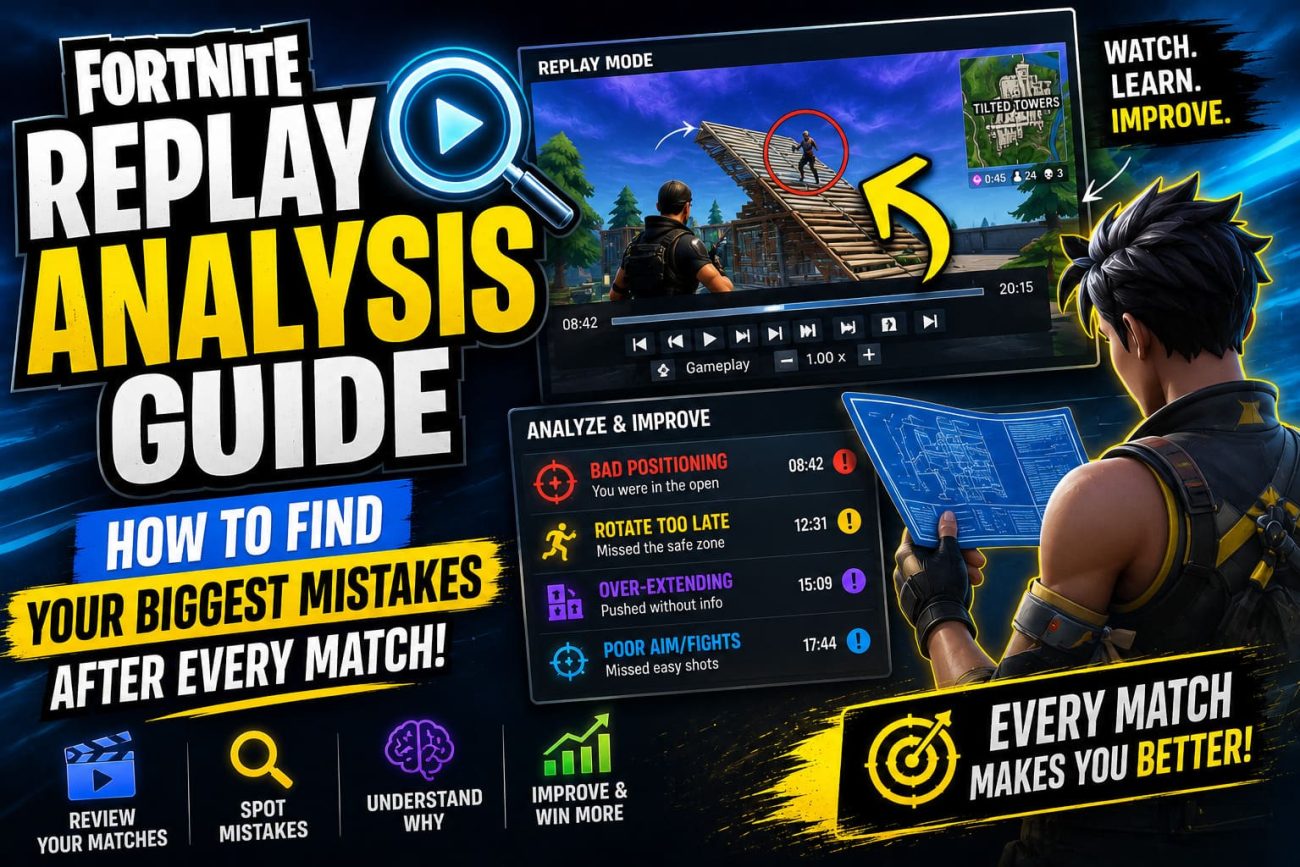
Winning a Fortnite match is satisfying, but losing can sometimes teach you more than winning – especially if you take a few minutes to understand why you lost.
Instead of immediately starting another match after an elimination, you can use Fortnite’s replay features to review important moments and identify mistakes that may be difficult to notice while playing.
A replay can show your positioning, rotations, fights, building decisions, timing, and interactions with other players from different perspectives. With a structured review process, you can turn a disappointing match into useful practice.
This guide explains how to analyze Fortnite replays, what mistakes to look for, and how to turn your observations into specific improvements.
Why Replay Analysis Is Useful
During a live match, you have limited information.
You’re focused on:
- Surviving
- Watching opponents
- Gathering resources
- Moving through the map
- Managing your inventory
- Building or editing
- Listening for audio cues
- Making decisions quickly
Because you’re concentrating on the next action, you may not recognize a mistake when it happens.
Replay analysis gives you an opportunity to slow down and look at the situation objectively.
For example, you might think:
“I lost because the other player had better aim.”
After reviewing the fight, you might discover that you were actually exposed from two directions and entered the engagement without enough cover.
That distinction is important.
If the real problem was positioning, practicing aim alone won’t completely solve it.
Start With Your Final Elimination
You don’t need to analyze an entire match every time.
A good starting point is the moment you were eliminated.
Ask yourself:
What happened during the 10–30 seconds before I died?
Look for:
- Where you were positioned
- Whether you had cover
- How many opponents were nearby
- Your health and shield
- Your available resources
- Your weapon selection
- Whether you knew where the enemy was
- Whether you started the fight voluntarily
This often reveals the immediate cause of the elimination.
Work Backward From the Mistake
Finding the final mistake is useful, but sometimes the real problem happened several minutes earlier.
For example:
Final elimination:
You get caught outside cover.
Earlier mistake:
You rotated through an exposed area.
Even earlier mistake:
You waited too long before moving toward the next safe area.
In this situation, the final elimination wasn’t the entire problem.
The real mistake was poor planning and timing.
This is why replay analysis should sometimes work backward from the final fight.
1. Analyze Your Landing
Your match can be influenced by decisions made within the first minute.
When reviewing your landing, look at:
- Where you landed
- How many players landed nearby
- Whether you had a realistic loot route
- How quickly you found useful equipment
- Whether you took unnecessary early fights
- Whether you had enough resources before rotating
Ask:
Did my landing give me a reasonable start?
A landing spot doesn’t have to be the most popular location to be good.
The important question is whether it consistently gives you a practical path into the rest of the match.
2. Review Your Looting Time
Looting is necessary, but spending too much time searching for better equipment can create problems.
During your replay, consider:
- How long you stayed in your first area
- Whether you searched unnecessary buildings
- Whether you ignored the approaching storm
- Whether you had enough equipment before leaving
- Whether you took fights simply because you were still in the area
You may discover that you’re spending too much time trying to find a perfect loadout.
The goal isn’t always to have the perfect inventory.
It’s to have enough resources to make the next decision safely.
3. Examine Your Rotations
Rotation mistakes are some of the easiest problems to miss while playing.
Watch the replay and ask:
Where did I move?
Why did I move there?
What information did I have?
What information did I ignore?
Was there a safer route?
A good rotation isn’t necessarily the shortest path.
Sometimes a slightly longer route provides:
- Better cover
- Better elevation
- More information
- Fewer potential enemy encounters
4. Look at Your Positioning
Positioning can determine whether a fight is easy or difficult before you even fire your weapon.
When reviewing your gameplay, pause before important engagements.
Ask:
What options did I have from this position?
Look for:
- Natural cover
- High ground
- Escape routes
- Nearby structures
- Open terrain
- Multiple enemy angles
A strong position usually gives you more options.
A weak position can leave you with nowhere to go when another player attacks.
5. Check Whether You Had Cover
One of the simplest replay-analysis questions is:
Was I standing somewhere safe?
If you repeatedly die while:
- Crossing open ground
- Standing beside a window
- Fighting without cover
- Moving through exposed terrain
then the problem may be positioning rather than aim.
Try to identify how often you enter fights without a reliable defensive option.
6. Review Your First Engagement
Your first serious fight can reveal a lot about your decision-making.
Look at:
- Who initiated the fight
- Whether you had information about the opponent
- Your initial position
- Your available cover
- Your health and shield
- Your weapon choice
- Whether you had an escape route
Then ask:
Was this fight necessary?
Not every fight is worth taking.
Sometimes the best decision is to disengage and reposition.
7. Analyze Your Aim Separately
If you lose a fight, don’t automatically assume your aim was the problem.
Replay the fight carefully.
Look at:
- Initial crosshair position
- Tracking
- Reaction time
- Shot timing
- Weapon selection
- Movement while shooting
- Whether you were surprised
If your crosshair was consistently close to the opponent but your shots missed, aim practice may help.
However, if the opponent had the better position and attacked you first, the more important lesson may be positioning.
8. Study Your Building and Editing
For players who use building mechanics, replays can reveal mistakes that are difficult to notice during a fight.
Look for:
- Unnecessary builds
- Poor cover placement
- Predictable patterns
- Slow edits
- Exposed angles
- Failed defensive builds
- Using too many resources unnecessarily
Don’t only look at whether the build looked impressive.
Ask:
Did the build actually improve my position?
A complicated build isn’t automatically a good build.
9. Review Your Resource Management
Resources can influence your options later in the match.
Look at your resource levels before major fights.
Ask:
- Did I use resources unnecessarily?
- Did I enter a fight with limited materials?
- Did I waste resources during a low-risk situation?
- Did I have enough resources to defend myself?
If you repeatedly reach important fights without enough resources, your earlier decisions may need adjustment.
10. Analyze Your Inventory Decisions
Your inventory is another area worth reviewing.
Before important fights, check:
- Which weapons you carried
- Healing availability
- Mobility options
- Utility items
- Ammunition
- Whether your inventory matched your playstyle
The goal isn’t to create one perfect inventory for every situation.
Instead, consider whether your inventory gave you practical options for the situations you encountered.
11. Look for Tunnel Vision
Tunnel vision happens when you become overly focused on one opponent, item, location, or objective.
In a replay, this can be surprisingly easy to spot.
For example:
You see an opponent → chase them → move into an exposed area → another player attacks → elimination.
The original enemy wasn’t necessarily the real problem.
The problem was losing awareness of everything around you.
During replay analysis, ask:
What information was I ignoring while focusing on this fight?
12. Review Your Audio Awareness
Audio can provide valuable information during a match.
If you were surprised by an opponent, ask whether there were clues you could have recognized.
Depending on the situation, you might have missed:
- Footsteps
- Gunfire
- Building sounds
- Vehicle movement
- Other nearby activity
You don’t need to hear every sound perfectly.
Instead, identify repeated situations where your awareness was consistently late.
13. Analyze Third-Party Situations
Sometimes you win a fight but immediately lose to another player.
Replay the entire sequence.
Ask:
Did I give other players enough time to reach me?
After a fight, consider:
- Your health
- Shield
- Resources
- Position
- Noise
- Nearby players
- Escape options
A victory isn’t necessarily a successful engagement if it leaves you in a terrible position for the next fight.
14. Study the Endgame
Endgame situations deserve special attention because mistakes become more costly as the number of remaining players decreases.
Review:
- Where you positioned yourself
- When you rotated
- How you entered the final area
- Whether you exposed yourself unnecessarily
- How you selected your fights
- Whether you maintained an escape route
Ask:
What decision put me in the final difficult situation?
The answer may have happened several minutes before your elimination.
Use Other Players’ Perspectives
One advantage of replay analysis is that you aren’t limited to your own perspective.
If possible, observe important moments from another player’s perspective.
This can help answer questions such as:
- Did the opponent know where I was?
- Was I visible before I realized it?
- Did I make too much noise?
- Was my movement predictable?
- Did I expose myself unnecessarily?
Seeing the same situation from another perspective can reveal information you couldn’t perceive during the actual match.
Don’t Analyze Every Second
A common mistake is trying to review an entire match in extreme detail.
That can take a long time without producing useful information.
Instead, focus on decision points.
Good moments to review include:
- Landing
- First major fight
- First rotation
- Important loot decisions
- Major fights
- Failed escapes
- Third-party encounters
- Final rotation
- Final elimination
These moments usually contain the decisions that had the greatest effect on the outcome.
Create a Mistake Hierarchy
Not every mistake deserves equal attention.
Try categorizing your mistakes into three levels.
Level 1 — Critical
Mistakes that directly contributed to your elimination.
Examples:
- Entering an unnecessary fight
- Rotating through open terrain
- Ignoring a dangerous position
Level 2 — Important
Mistakes that reduced your options.
Examples:
- Poor inventory management
- Wasting resources
- Taking too long to rotate
Level 3 — Minor
Small mechanical errors.
Examples:
- A missed shot
- Slightly imperfect movement
- A slow edit
Work on Level 1 mistakes first.
Fixing a major decision-making problem will usually provide more value than trying to eliminate every small mechanical error.
Keep a Simple Replay Journal
You can track your progress with a simple table.
| Match | Main Mistake | Why It Happened | Improvement |
|---|---|---|---|
| 1 | Bad rotation | Waited too long | Rotate earlier |
| 2 | Lost cover | Chased opponent | Stay near cover |
| 3 | Poor inventory | Over-looted | Leave area sooner |
| 4 | Third-party elimination | Stayed too long after fight | Reposition quickly |
After several matches, patterns become easier to identify.
You may discover that the same mistake is appearing repeatedly.
That is valuable information.
Turn Observations Into Specific Goals
Don’t finish a replay review with:
“I need to play better.”
That’s too vague.
Instead, create a specific goal.
For example:
Weak goal:
“I need better positioning.”
Better goal:
“During my next five matches, I’ll prioritize taking fights from cover.”
Or:
Weak goal:
“I need better rotations.”
Better goal:
“I’ll start planning my next rotation before the storm forces me to move.”
Specific goals are easier to practice and evaluate.
A 10-Minute Replay Review Routine
You don’t need to spend an hour analyzing every match.
Try this quick routine.
Minute 1–2: Watch the elimination
Determine what happened immediately before you died.
Minute 3–4: Work backward
Find the earlier decision that created the situation.
Minute 5–6: Review positioning
Check your cover, route, elevation, and available escape options.
Minute 7–8: Review mechanics
Look at aim, movement, building, and weapon selection.
Minute 9: Identify the biggest mistake
Choose one mistake rather than ten.
Minute 10: Create your next goal
Turn that mistake into a specific action for your next match.
This approach keeps replay analysis practical instead of overwhelming.
Fortnite Replay Analysis Checklist
Before finishing your review, ask:
- Where did I land and why?
- Did I spend too long looting?
- Did I rotate early enough?
- Was I usually near cover?
- Did I take unnecessary fights?
- Did I have enough resources?
- Was my inventory suitable for the situation?
- Did I lose awareness of nearby players?
- Did I recognize audio information?
- Did I stay too long after winning a fight?
- Was my final position safe?
- What was my biggest mistake?
- What will I practice in my next match?
Final Thoughts
Fortnite replay analysis is most useful when you use it to answer specific questions.
You don’t need to watch every second of every match. Start with your final elimination, work backward through the important decisions, and identify the earliest mistake that contributed to the situation.
Pay particular attention to positioning, rotations, fight selection, resource management, awareness, and decision-making.
Most importantly, don’t try to fix everything at once.
Choose one recurring mistake, create a specific goal, and look for improvement in your next few matches.
