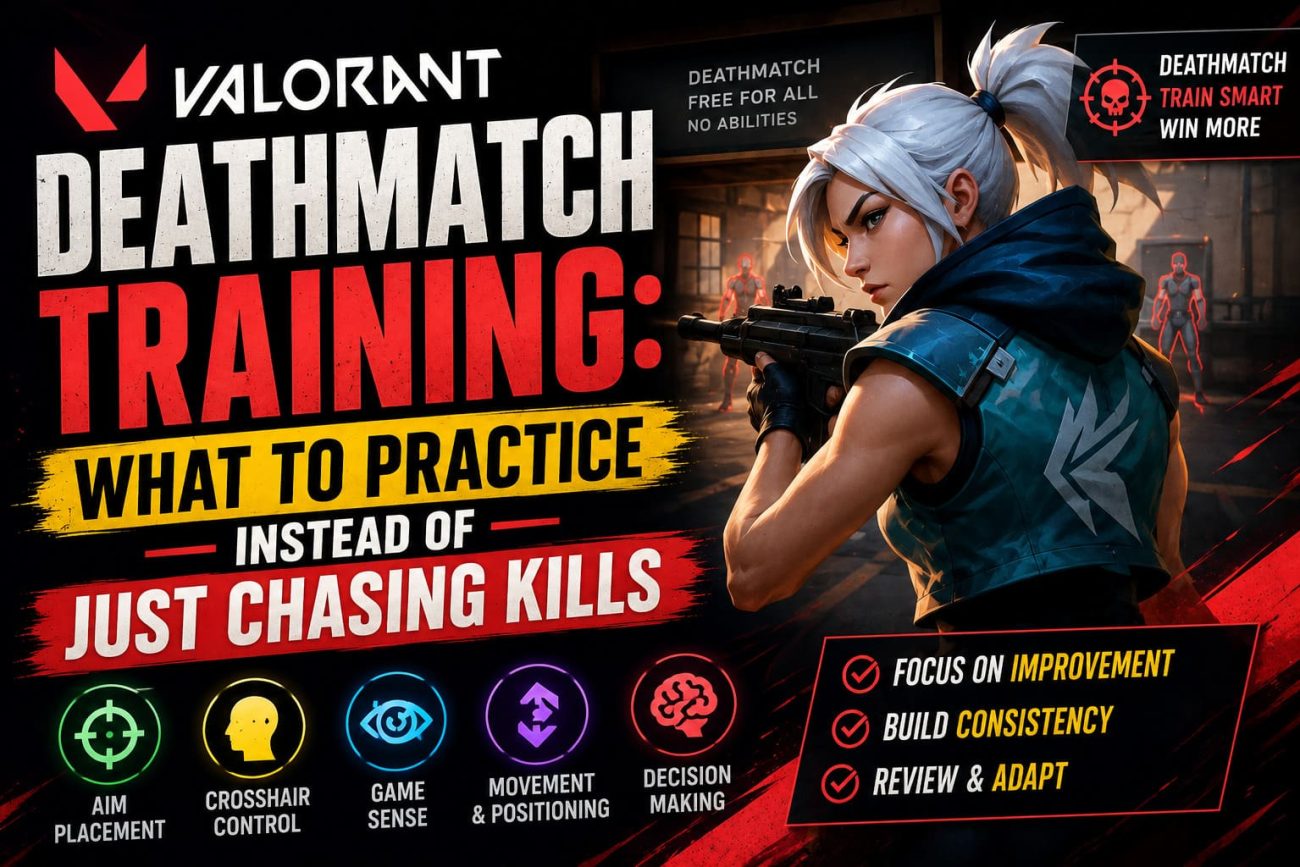
Valorant Deathmatch is one of the easiest ways to practice your mechanics without worrying about round economy, team strategies, or losing a competitive match. However, many players use Deathmatch mainly as a race to the top of the scoreboard.
That can limit how much they actually learn.
If your goal is to become a more consistent Valorant player, Deathmatch should be treated as a training environment, not simply another game mode where the only objective is getting the most eliminations.
Instead of obsessing over your kill count, you can use each match to deliberately practice crosshair placement, movement, first-shot accuracy, positioning, weapon control, and decision-making.
This guide explains what to focus on during Deathmatch and how to turn ordinary matches into structured practice sessions.
Why Deathmatch Is Useful for Training
Deathmatch removes many of the variables found in a normal competitive match.
You don’t have to worry about:
- Buying weapons
- Saving credits
- Coordinating a full team
- Managing round time
- Protecting the spike
- Choosing an agent strategy
- Losing an entire match because of one mistake
Instead, you get repeated opportunities to take gunfights.
That makes Deathmatch particularly useful for improving mechanical consistency.
However, the key is to enter the mode with a specific training goal.
If you simply run around looking for kills, you may reinforce habits that don’t translate well to ranked games.
1. Focus on Crosshair Placement
One of the most valuable skills to practice in Deathmatch is keeping your crosshair at the correct height.
Ideally, your crosshair should already be positioned around the level where an opponent’s head is likely to appear.
This reduces the amount of adjustment required when an enemy appears.
Instead of thinking:
“I need to react faster.”
Think:
“Can I position my crosshair correctly before the enemy appears?”
This is a much more reliable skill.
How to Practice Crosshair Placement
For an entire Deathmatch, make crosshair placement your only priority.
Pay attention to:
- Head height
- Common angles
- Doorways
- Corners
- Elevation changes
- Whether you’re aiming too close to the ground
Don’t worry if your kill count decreases.
If you consistently place your crosshair correctly, you’re developing a habit that can benefit your competitive matches.
Simple exercise
Walk around the map normally and imagine where an opponent’s head would appear before you expose yourself to an angle.
Then position your crosshair there.
Repeat this throughout the entire match.
2. Practice First-Shot Accuracy
Winning gunfights isn’t always about shooting faster.
The first accurate shot can be extremely important, especially when using rifles and other precision weapons.
Deathmatch gives you many opportunities to practice taking controlled opening shots.
Instead of immediately spraying when you see someone, try to develop the habit of:
See → Stop → Aim → Shoot
rather than:
See → Panic → Spray
This can help improve your consistency.
3. Stop Shooting While Moving
One common mistake among developing players is attempting to move and shoot at the same time.
Valorant’s gunplay rewards controlled movement and accurate shooting.
Use Deathmatch to practice separating your movement from your shots.
For example:
- Move toward an angle.
- Spot the opponent.
- Stop your movement.
- Place your crosshair.
- Fire.
- Move again.
This may initially feel slower.
That’s okay.
You’re practicing a repeatable mechanic rather than simply trying to win individual fights.
4. Practice Counter-Strafing and Movement Control
Movement mechanics can also be practiced during Deathmatch.
When changing direction, focus on getting your character under control before firing.
For example, if you’re moving left and need to shoot an opponent on your right:
Movement → Stop → Aim → Fire
The goal is to make this sequence automatic.
Don’t turn every fight into a movement experiment, though. Choose a specific mechanic to practice and repeat it consistently.
5. Practice One Weapon at a Time
Deathmatch is an excellent place to become comfortable with individual weapons.
Instead of switching weapons constantly, dedicate sessions to specific guns.
For example:
Session 1
Vandal
Focus on:
- Burst control
- Head-level crosshair placement
- First-shot accuracy
Session 2
Phantom
Focus on:
- Controlled sprays
- Close-to-medium range fights
- Recoil management
Session 3
Sheriff
Focus on:
- Precision
- Patience
- Headshots
You don’t need to use every weapon during every session.
Focused repetition can make your practice more meaningful.
6. Learn Recoil Control
Different weapons behave differently when you fire continuously.
If you rely entirely on spraying without understanding the weapon’s recoil, your accuracy can suffer.
Deathmatch gives you plenty of opportunities to learn how a weapon behaves.
Start by practicing:
- Short bursts
- Controlled sprays
- Resetting your aim
- Pulling your mouse appropriately during longer sprays
Don’t worry about memorizing every bullet trajectory immediately.
Start by learning how the weapon feels.
7. Practice Different Engagement Distances
Players sometimes develop good aim at one distance but struggle at another.
Use Deathmatch to deliberately experience:
- Close-range fights
- Medium-range fights
- Long-range fights
Your shooting approach should change depending on distance.
At longer distances, controlled bursts and precision are often more useful than blindly spraying.
At closer distances, faster reactions and appropriate movement can become more important.
The goal is to become comfortable adapting to the situation.
8. Don’t Chase Every Enemy
This is one of the biggest differences between training and simply playing Deathmatch.
If you hear gunfire behind you, you don’t always need to immediately turn around and chase the player.
Constantly chasing kills can teach you to:
- Overpeek
- Ignore positioning
- Swing unnecessarily
- Expose yourself to multiple angles
Instead, practice taking fights from reasonable positions.
Ask yourself:
“Would I take this fight in a real competitive round?”
If the answer is no, think about why.
9. Practice Clearing Angles
Deathmatch can also help you develop better map-clearing habits.
When moving through an area, don’t randomly stare around the map.
Instead, practice checking likely enemy positions systematically.
For example:
Close angle → Common angle → Deep angle → Move forward
This can help you develop better visual discipline.
The exact order depends on the map and situation, but the principle remains the same:
Clear deliberately instead of looking everywhere at once.
10. Practice Peeking Technique
Deathmatch provides countless opportunities to practice peeking.
Try different approaches:
Wide peek
Useful when you expect an opponent to hold a tight angle and you want to change the distance of the engagement.
Tight peek
Useful when you want to expose less of your character while checking an angle.
Jiggle peek
Can be useful for gathering information or forcing an opponent to react.
Shoulder peek
Can help you practice showing a small amount of your character without fully committing to the fight.
Don’t use every technique randomly.
Choose one and practice it intentionally.
11. Practice Holding Angles
Deathmatch doesn’t have to mean constantly running around.
Sometimes you should practice holding an angle.
Find a reasonable position and focus on:
- Crosshair placement
- Patience
- Reaction time
- Movement discipline
When an opponent appears, focus on executing the shot correctly.
This can help balance your practice between attacking and defending.
12. Practice Your Weak Side
Many players naturally feel more comfortable taking fights in one direction or from certain positions.
Pay attention to situations where you repeatedly miss.
For example:
- Enemies appearing from your left
- Close-range fights
- Long-range fights
- Fast targets
- Enemies swinging wide
- Enemies holding off-angles
Once you identify a weakness, deliberately practice it.
Improvement becomes much easier when you know what you’re trying to improve.
13. Don’t Judge Your Session Only by Kills
The scoreboard can be useful, but it shouldn’t be your only measurement.
A Deathmatch with 25 kills isn’t necessarily more valuable than one with 15 kills.
You might have spent the second match practicing:
- Better crosshair placement
- Cleaner movement
- Controlled bursts
- Better peeking
- A difficult weapon
Instead of asking:
“How many kills did I get?”
Ask:
“Did I execute the skill I wanted to practice?”
That is a much better training metric.
14. Use Short, Focused Sessions
You don’t necessarily need to play Deathmatch for hours.
Long sessions can become repetitive, and your concentration may decrease.
A simple routine could look like this:
5 Minutes — Warm-Up
Focus on:
- Comfortable mouse movement
- Crosshair placement
- Basic shooting
10–15 Minutes — Focused Practice
Choose one skill:
- First-shot accuracy
- Movement
- Peeking
- Recoil
- Head-level crosshair placement
5 Minutes — Evaluation
Think about:
- What felt comfortable?
- What did you miss?
- Which fights were difficult?
- What should you practice next?
The important part isn’t the exact duration.
Consistency matters more than marathon sessions.
A Simple Deathmatch Training Routine
Here’s an example routine you can repeat.
| Session | Main Focus | Goal |
|---|---|---|
| 1 | Crosshair placement | Keep aim at head level |
| 2 | Movement | Stop before shooting |
| 3 | First-shot accuracy | Improve opening shots |
| 4 | Recoil | Control bursts and sprays |
| 5 | Peeking | Practice different peek styles |
| 6 | Long-range fights | Improve precision |
| 7 | Weakness practice | Target your biggest problem |
You can repeat the cycle and adjust it based on your progress.
Mistakes to Avoid During Deathmatch
Chasing the scoreboard
Trying to finish first can encourage bad habits.
Constantly sprinting around
Movement without purpose doesn’t automatically improve your gameplay.
Spraying every fight
Learn when controlled bursts or single shots are appropriate.
Ignoring crosshair placement
Fast reactions cannot completely compensate for poor initial positioning.
Practicing everything at once
Pick one or two goals per session.
Getting frustrated by deaths
Deaths are useful feedback during training.
Instead of thinking:
“That player got lucky.”
Ask:
“What could I have done differently?”
How to Track Your Improvement
You don’t need complicated statistics.
After each session, write down three things:
1. What did I practice?
Example:
Crosshair placement
2. What improved?
Example:
I was consistently keeping my crosshair closer to head level.
3. What needs work?
Example:
I still aim too low when entering new areas.
After several sessions, you’ll start seeing patterns.
You can then adjust your training accordingly.
Deathmatch vs. Competitive Practice
Deathmatch is useful, but it can’t replace actual competitive gameplay.
Deathmatch is particularly good for:
- Aim
- Movement
- Crosshair placement
- Weapon familiarity
- Peeking
- Reaction practice
Competitive matches are necessary for developing:
- Team communication
- Utility usage
- Economy management
- Site execution
- Retakes
- Rotation decisions
- Round management
- Positioning with teammates
A balanced practice routine should include both.
Final Thoughts
Valorant Deathmatch becomes much more useful when you stop treating it as a simple race for kills.
The scoreboard is only one measurement.
Your real goal should be developing repeatable mechanics that transfer into real matches.
Focus on one skill at a time. Practice proper crosshair placement, controlled movement, first-shot accuracy, peeking, recoil control, and positioning.
Most importantly, don’t become discouraged when your kill count drops while learning something new.
If you finish a Deathmatch with fewer kills but significantly better mechanics, the session may have been more valuable than a high-scoring match where you simply chased opponents around the map.
