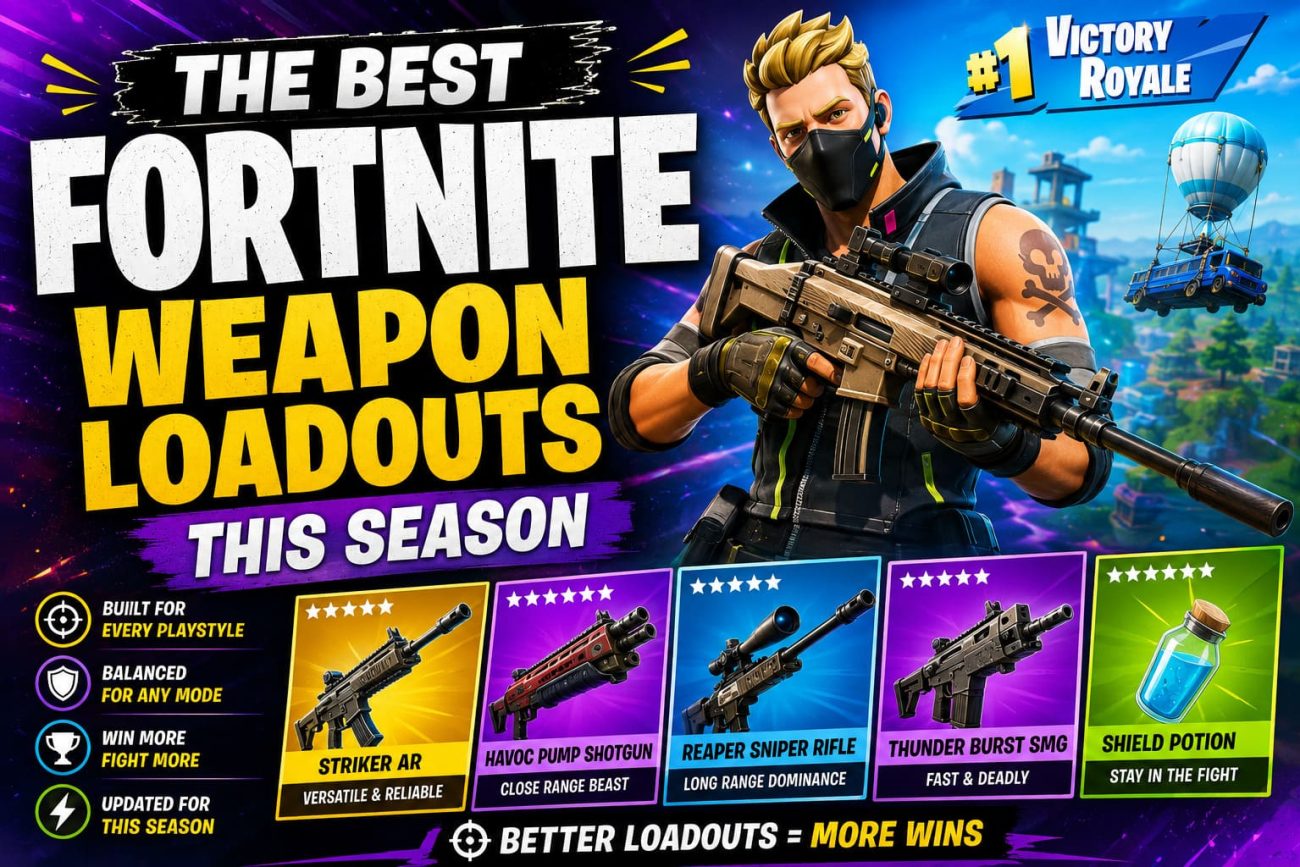
Finding the right weapon combination in Fortnite can make a huge difference between getting eliminated early and surviving until the final circle. Instead of carrying whatever weapons you find first, a balanced loadout gives you options for close-range fights, mid-range damage, long-range pressure, mobility, and healing.
The best Fortnite loadout isn’t necessarily the same for every player. Aggressive players may prefer a shotgun and fast-firing weapon, while players who prefer to fight from a distance may want an assault rifle or marksman weapon.
In this guide, we’ll look at practical Fortnite weapon loadouts for different playstyles, including aggressive players, balanced players, long-range fighters, beginners, solo players, and Zero Build players.
Editor’s note: Fortnite’s weapons, items, and balance can change with seasonal and mid-season updates. Always check the current in-game loot pool before relying on a specific weapon combination.
What Makes a Good Fortnite Loadout?
A strong loadout should cover several different situations instead of focusing entirely on one type of weapon.
Ideally, your inventory should give you:
- A reliable primary weapon
- A strong close-range option
- A secondary weapon for finishing opponents
- A mobility or utility item
- Healing or shield items
For example, carrying two weapons that perform almost identically at the same range can leave you vulnerable when an opponent changes the distance of the fight.
A balanced inventory gives you more ways to react.
1. Balanced Fortnite Loadout
A balanced setup is usually the safest choice for players who don’t want to specialize in one particular fighting style.
Recommended setup
Slot 1: Assault rifle or accurate primary weapon
Slot 2: Shotgun
Slot 3: SMG, pistol, or secondary damage weapon
Slot 4: Mobility or utility
Slot 5: Healing or shields
Why this loadout works
Your primary weapon handles medium-range engagements, while the shotgun gives you an answer when an opponent pushes into close range.
The third weapon can help finish weakened opponents or provide additional damage when your primary weapon is reloading.
The final two slots should generally be used for mobility and survivability.
This setup is particularly useful for players who frequently encounter different types of fights during a match.
2. Aggressive Loadout
If your preferred strategy is pushing opponents instead of waiting for them, you need weapons that perform well during fast engagements.
Recommended setup
Slot 1: Assault rifle or fast-firing primary
Slot 2: Shotgun
Slot 3: SMG or close-range secondary
Slot 4: Mobility
Slot 5: Shields or healing
How to play it
Start the engagement with your primary weapon to deal damage from a safer distance.
Once you have cracked an opponent’s shields or created an opening, close the distance and use your shotgun.
An SMG or similar fast-firing weapon can then be useful for applying continuous pressure when the opponent is trying to escape.
The biggest mistake aggressive players make is pushing without an escape option. Keep at least one mobility or repositioning item whenever the current loot pool provides one.
3. Long-Range Loadout
Some players are much more comfortable fighting from a distance.
For this playstyle, accuracy and range are more important than maximum close-range damage.
Recommended setup
Slot 1: Assault rifle
Slot 2: Marksman or long-range weapon
Slot 3: Shotgun
Slot 4: Mobility
Slot 5: Healing or shields
Why it works
The assault rifle can handle general mid-range fights, while a marksman-style weapon lets you pressure opponents before they get close.
However, don’t fill your entire inventory with long-range weapons.
Eventually, another player will push you. A shotgun gives you a much better chance of surviving that close-range encounter.
4. Zero Build Loadout
Zero Build changes the way you should think about your inventory.
Without structures to protect you, movement, cover, positioning, and healing become especially important.
Recommended setup
Slot 1: Reliable assault rifle
Slot 2: Shotgun
Slot 3: SMG or secondary weapon
Slot 4: Mobility
Slot 5: Shields or healing
Why mobility matters
In Zero Build, you cannot simply build a wall when an opponent starts shooting.
That makes repositioning extremely important.
A mobility item can help you:
- Escape a bad engagement
- Reach natural cover
- Rotate before the storm closes
- Chase a weakened opponent
- Disengage from third-party attacks
A player with average aim but excellent positioning can often outperform someone with better aim who stands in the open.
5. Beginner-Friendly Loadout
New Fortnite players shouldn’t worry about copying the exact inventory used by professional players.
Instead, focus on weapons that are easy to understand and use.
Recommended setup
Slot 1: Assault rifle
Slot 2: Shotgun
Slot 3: Easy-to-control secondary weapon
Slot 4: Mobility or utility
Slot 5: Shields or healing
Why beginners should use this setup
An assault rifle teaches you how to manage medium-range fights, while a shotgun helps you learn close-range combat.
You also learn an important Fortnite habit: keeping utility and healing instead of filling every slot with weapons.
As your aim and game sense improve, you can experiment with more specialized loadouts.
6. Solo Loadout
Solo matches require you to handle every situation yourself.
You don’t have teammates who can revive you, provide cover, or carry additional utility.
Recommended setup
Slot 1: Primary weapon
Slot 2: Shotgun
Slot 3: Secondary damage weapon
Slot 4: Mobility
Slot 5: Healing or shields
Solo strategy
Avoid carrying too many weapons that serve the same purpose.
Your inventory should give you an answer to three major situations:
- An enemy attacks from a distance.
- An enemy pushes you at close range.
- You need to escape or recover after taking damage.
A balanced inventory is generally more useful in solos than an extremely specialized one.
7. Squad Loadout
Squad matches require a slightly different approach.
You don’t necessarily need every member of your team to carry identical weapons.
Instead, teammates can divide utility and healing responsibilities.
For example, one player might prioritize long-range pressure while another focuses on close-range fights.
General squad setup
Primary weapon: Assault rifle or other reliable ranged weapon
Secondary: Shotgun or close-range weapon
Third slot: Flexible damage weapon
Fourth slot: Mobility or team utility
Fifth slot: Healing/shields
Communication is often more important than having the theoretically perfect weapon.
If one teammate finds a useful item that another teammate needs, sharing resources can be more valuable than keeping everything for yourself.
How to Choose the Best Fortnite Weapons
Don’t choose a weapon only because someone called it “meta.”
A weapon’s effectiveness depends on your aim, playstyle, range preference, and the situation you’re in.
Consider these five factors:
1. Range
Ask yourself where you usually fight.
If you constantly fight at medium range, prioritize a reliable primary weapon.
If you frequently push buildings or enclosed areas, a strong close-range option becomes more important.
2. Accuracy
A weapon with high theoretical damage isn’t useful if you consistently miss your shots.
A slightly less powerful weapon that you can control may produce better results.
3. Reload speed
Reload time becomes extremely important during close fights.
If you empty your magazine and have to wait while an opponent continues attacking, you can quickly lose the engagement.
4. Magazine size
Larger magazines can be useful when fighting multiple enemies, especially in squad matches.
However, larger magazines don’t automatically make a weapon better.
5. Utility
Weapons aren’t everything.
Mobility, healing, shields, and other utility items can determine whether you survive a difficult fight.
Don’t Carry Too Many Weapons
One of the most common inventory mistakes is carrying too many guns.
For example, carrying four weapons can sound powerful, but it leaves very little room for healing and utility.
A player who has several strong weapons but no healing may still lose the match after one bad engagement.
A better approach is to build your inventory around roles:
Damage + close-range + flexibility + mobility + survivability
This gives you a much wider range of options.
How to Build a Loadout From Random Loot
You won’t always find your preferred weapons after landing.
That’s completely normal.
Instead of waiting for the perfect loadout, build the best inventory available.
For example, if you find a good assault rifle first, use it as your primary weapon.
Then prioritize finding a close-range weapon.
After that, look for mobility and healing.
This approach is much more practical than ignoring useful weapons because they aren’t part of your planned loadout.
When Should You Change Your Loadout?
Your inventory should change as the match develops.
Early in the game, you may carry whatever weapons you can find.
During the middle of the match, you can replace weaker weapons with better versions.
Near the final circles, positioning and utility become increasingly important because fights can happen at short distances and third parties are more common.
Don’t be afraid to replace a weapon if you find something that better matches your current situation.
Common Fortnite Loadout Mistakes
Carrying only damage weapons
Five weapons might look impressive, but you may struggle to survive without healing or mobility.
Using weapons you can’t control
A weapon isn’t automatically good for you just because it is popular.
Practice with different weapons and find what matches your aim.
Ignoring mobility
Being able to reposition can be just as important as dealing damage.
Carrying duplicate weapons
Two weapons designed for exactly the same range can waste valuable inventory space.
Forgetting healing
Even if you’re winning fights, you’ll eventually take damage.
Keeping recovery items can make the difference between surviving and getting eliminated shortly afterward.
How to Improve Your Loadout Over Time
The best way to find your personal Fortnite loadout is to experiment.
After every match, ask yourself:
- Which weapon did I use most?
- Which weapon did I rarely use?
- Did I have enough close-range damage?
- Did I have enough range?
- Did I run out of shields or healing?
- Did I have a way to escape difficult fights?
- Which weapon felt easiest to control?
After several matches, you’ll start to see a pattern.
Your personal “best loadout” may be different from the loadout recommended by competitive players, and that’s perfectly fine.
Final Thoughts
There isn’t one Fortnite loadout that is perfect for every player or every match.
The strongest setup is usually the one that gives you reliable damage at your preferred range while also leaving room for mobility, healing, and utility.
For most players, a balanced combination of a primary weapon, close-range weapon, secondary damage option, mobility item, and healing or shields is a strong starting point.
As Fortnite’s loot pool changes, individual weapons will come and go. Instead of memorizing one permanent inventory, learn how to build a loadout around your playstyle and the items available in the current match.
That skill will remain useful even when the Fortnite meta changes.
Frequently Asked Questions
What is the best Fortnite loadout?
There isn’t one universally best loadout. A balanced setup containing a reliable primary weapon, close-range weapon, mobility, and healing is a good choice for most players.
Should I carry two shotguns?
Usually, it’s better to use your inventory space for different roles unless the current weapon pool or your specific strategy makes a second close-range weapon worthwhile.
What is the best loadout for beginners?
Beginners should generally start with an easy-to-control primary weapon, a shotgun, mobility or utility, and healing or shields.
Is the same loadout good for Build and Zero Build?
Not always. Zero Build places greater importance on mobility, positioning, and natural cover because you cannot create your own structures for protection.
Should I copy professional Fortnite players’ loadouts?
Professional players can provide useful ideas, but their loadouts may be designed around a very different skill level and playstyle. Experiment and find what works for you.
How often should I update a Fortnite loadout guide?
Update the article whenever a major seasonal or loot-pool change affects the weapons discussed. Fortnite’s official updates and Battle Royale announcements are useful references for tracking those changes.
