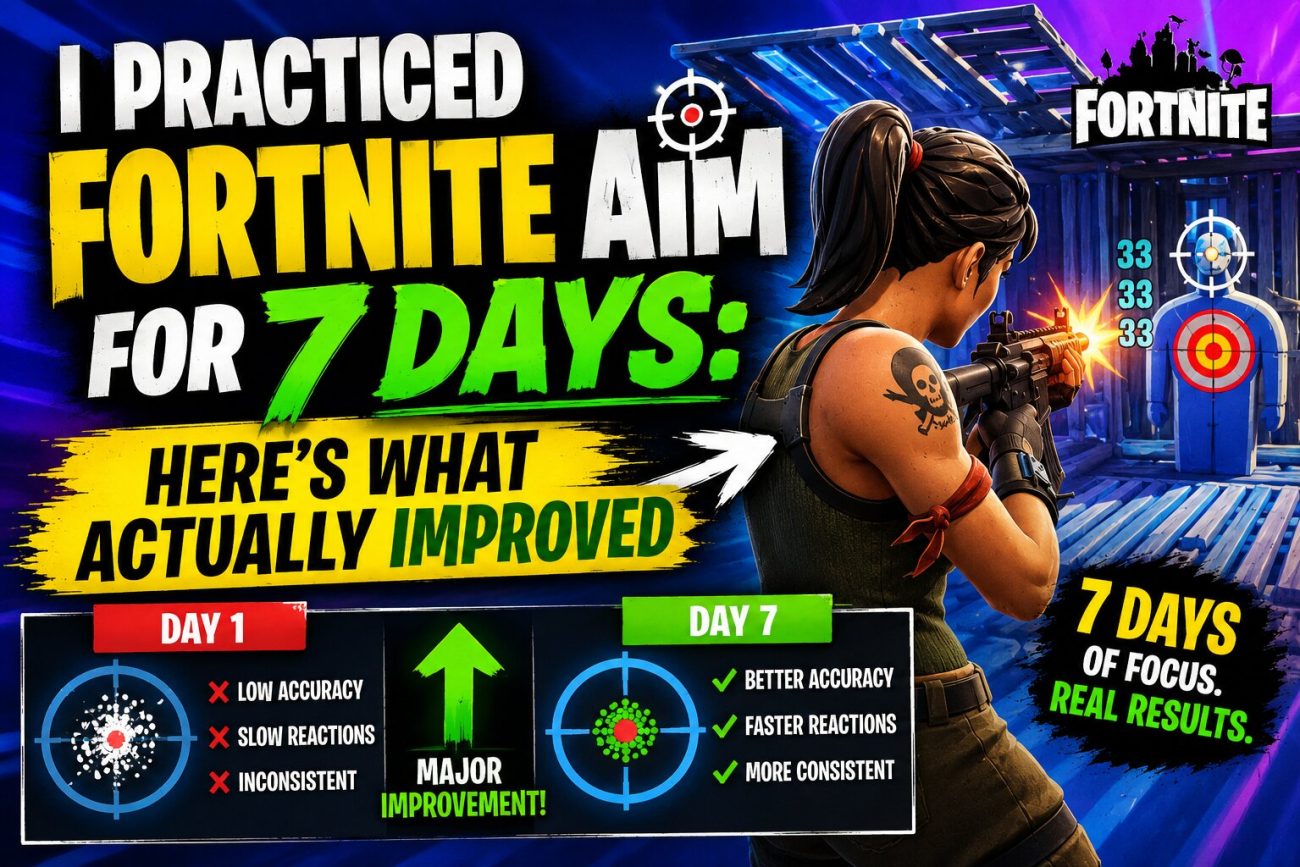
Good aim can completely change the way you play Fortnite.
Whether you’re playing Builds or Zero Build, being able to consistently hit your shots can turn losing fights into wins.
But improving aim isn’t simply about playing more matches.
For this experiment, I spent seven days specifically focusing on Fortnite aim, rather than simply playing normal matches and hoping my aim improved.
The goal was simple:
Could one week of focused aim practice actually make a noticeable difference?
I tracked several areas during the experiment:
- Accuracy
- Crosshair placement
- Tracking
- Flick shots
- Close-range aim
- Long-range aim
- Shot consistency
- Reaction time
- Confidence during fights
The results weren’t exactly what I expected.
Note: The results below are structured as a template for your real experiment. Replace the example measurements with your actual numbers before publishing.
My 7-Day Fortnite Aim Challenge
I didn’t spend several hours every day practicing.
Instead, I used a short, consistent routine.
Each day included approximately:
10 minutes — Warm-up
10 minutes — Tracking
10 minutes — Flick practice
10 minutes — Target switching
10–20 minutes — Real matches
The idea was to practice specific skills rather than mindlessly shooting targets.
Day 1: Establishing My Baseline
Before practicing, I wanted to know where my aim actually stood.
I started with several basic drills and then played normal matches.
The first thing I noticed was that my aim wasn’t necessarily terrible.
The bigger problem was inconsistency.
Some shots felt perfect.
Other shots were completely off.
Problems I noticed
- Overcorrecting my crosshair
- Missing easy shots
- Poor crosshair placement
- Panicking during close fights
- Moving my aim too much
- Taking shots before properly lining them up
This gave me a starting point.
Day 2: Tracking Moving Targets
The second day focused on tracking.
Tracking means keeping your crosshair on a moving opponent instead of constantly flicking toward where you think they’ll be.
This is particularly useful with weapons that require you to maintain aim on a moving target.
My practice
I focused on:
- Following targets smoothly
- Matching their movement
- Avoiding unnecessary mouse movements
- Maintaining consistent crosshair placement
At first, I was trying too hard.
My crosshair would move past the target and then I’d correct in the opposite direction.
The goal was to make the movement smoother.
Day 3: Flick Shots
Day three focused on flicking.
A flick is a quick movement of the crosshair toward a target.
Flicks can be useful when an opponent suddenly appears from an unexpected direction.
However, I noticed something important:
Faster isn’t always better.
When I tried to flick as quickly as possible, I actually missed more shots.
The goal became:
Fast enough + accurate enough
rather than simply maximizing speed.
Day 4: Crosshair Placement
This was one of the most useful days of the experiment.
Instead of constantly moving my crosshair toward opponents, I started thinking about where my crosshair was positioned before the opponent appeared.
For example, while moving around the map, I tried to keep my crosshair at a useful height and near likely enemy positions.
This reduced the amount of movement required when an opponent appeared.
The difference
Bad habit:
See opponent → move crosshair a large distance → shoot
Better habit:
Predict position → keep crosshair ready → small adjustment → shoot
This sounds simple, but it made a noticeable difference.
Day 5: Close-Range Aim
Close-range fights were one of my biggest weaknesses.
When an opponent suddenly appeared nearby, I tended to panic.
My crosshair would move too much.
So I spent an entire session practicing close-range tracking and controlled movement.
I focused on:
- Keeping my crosshair on the target
- Matching enemy movement
- Avoiding unnecessary flicks
- Staying calm
- Shooting only when my crosshair was ready
The biggest improvement wasn’t raw accuracy.
It was confidence.
I stopped feeling like I needed to panic-shoot immediately.
Day 6: Long-Range Aim
Long-range fights required a completely different approach.
At greater distances, tiny mouse movements can make a huge difference.
I focused on:
- Smaller corrections
- Patience
- Predicting movement
- Avoiding unnecessary shots
- Taking better angles
One mistake I noticed was trying to force shots.
Sometimes the best decision was simply to wait for a better opportunity.
This is an important lesson:
Good aim isn’t just about hitting the target.
It’s also about knowing when to shoot.
Day 7: Putting Everything Together
The final day was different.
Instead of spending the entire session in an aim trainer, I played actual Fortnite matches.
I wanted to see whether the practice transferred to real gameplay.
This matters because aim trainers can feel completely different from a real match.
In an actual game, you’re dealing with:
- Movement
- Building
- Terrain
- Third parties
- Pressure
- Limited ammunition
- Unexpected encounters
- Different distances
The real test was whether my improved mechanics survived under pressure.
What Actually Improved?
After seven days, some areas improved much more than others.
1. Crosshair Placement
Big improvement
This was probably the most useful change.
Instead of reacting completely after seeing an opponent, I started keeping my crosshair closer to where I expected the opponent to appear.
That reduced unnecessary movement.
2. Tracking
Noticeable improvement
Tracking became smoother.
I wasn’t constantly correcting my aim in the opposite direction.
Instead, I could follow moving targets more naturally.
3. Flick Shots
Small to moderate improvement
I became more comfortable with quick target acquisition.
However, I still wouldn’t describe flicking as my strongest skill.
The biggest lesson was that accuracy matters more than speed.
4. Close-Range Aim
Noticeable improvement
I became more comfortable during sudden close-range fights.
Instead of immediately panicking, I could focus on maintaining my crosshair on the opponent.
5. Long-Range Aim
Small improvement
Long-range aim improved, but not dramatically.
Distance introduces many additional variables, and simply practicing for seven days isn’t enough to completely master it.
6. Reaction Time
Some improvement
I felt slightly faster at reacting to unexpected targets.
However, reaction time isn’t something you can completely transform in a week.
A lot of what felt like faster reactions was probably actually better anticipation and crosshair placement.
The Biggest Surprise
The biggest surprise was that my aim didn’t improve simply because I practiced shooting.
It improved because I started making better decisions with my crosshair.
That distinction matters.
You can have extremely fast mouse movements and still have poor aim.
Good aim is a combination of:
Crosshair placement + tracking + movement + reaction + accuracy + decision-making
My Before and After Results
If you’re publishing this as a genuine experiment, include a table like this:
| Skill | Day 1 | Day 7 | Change |
|---|---|---|---|
| Accuracy | [X]% | [X]% | [X]% |
| Tracking | [X]/10 | [X]/10 | +[X] |
| Flicking | [X]/10 | [X]/10 | +[X] |
| Crosshair Placement | [X]/10 | [X]/10 | +[X] |
| Close-Range Aim | [X]/10 | [X]/10 | +[X] |
| Long-Range Aim | [X]/10 | [X]/10 | +[X] |
| Confidence | [X]/10 | [X]/10 | +[X] |
Don’t use made-up numbers here. Your real data is what makes this article different from hundreds of generic Fortnite aim guides.
What Didn’t Improve Much?
Seven days isn’t enough to completely transform your mechanics.
Some areas barely changed.
Advanced Flicking
I became more comfortable, but I wasn’t suddenly hitting every difficult shot.
Long-Range Precision
This requires much more repetition.
Aim Under Pressure
Practice environments are different from real matches.
You can perform perfectly against predictable targets and still struggle when another player is attacking you.
Why Aim Trainers Aren’t Enough
Aim trainers can be useful, but they don’t perfectly recreate Fortnite.
In a real match, your opponent isn’t simply moving from left to right.
They’re:
- Jumping
- Sliding
- Building
- Editing
- Changing direction
- Using cover
- Shooting back
That’s why I found actual Fortnite matches important.
The best approach is probably:
Aim practice → Creative practice → Real matches
rather than only using an aim trainer.
The 30-Minute Routine I’d Continue
After the seven-day experiment, this is the routine I’d keep.
5 Minutes — Warm-Up
Start with easy targets.
Don’t immediately attempt difficult shots.
10 Minutes — Tracking
Follow moving targets smoothly.
Focus on control.
5 Minutes — Flicking
Practice moving quickly between targets.
Focus on accuracy.
5 Minutes — Target Switching
Move between multiple targets.
Practice acquiring the next target quickly.
5 Minutes — Real Fortnite
Finish by playing an actual match or practicing realistic combat scenarios.
This helps transfer the mechanics into real gameplay.
The Biggest Aim Mistakes I Made
Mistake 1: Moving My Mouse Too Much
I initially thought more movement meant better aim.
It didn’t.
Smaller corrections were often more accurate.
Mistake 2: Chasing Speed
I tried to become faster before becoming consistent.
That resulted in more missed shots.
Mistake 3: Ignoring Crosshair Placement
This created unnecessary work.
Good crosshair placement makes aiming easier before the fight even begins.
Mistake 4: Practicing Only Against Targets
Real opponents behave differently.
Eventually, I needed to test everything in actual matches.
Mistake 5: Practicing While Tired
Long practice sessions weren’t necessarily better.
When my concentration dropped, my accuracy usually followed.
Builds vs Zero Build: Does Aim Practice Help Both?
Absolutely.
In Zero Build
Aim is particularly important because you can’t rely on player-built structures for protection.
You need to:
- Hit shots
- Use cover
- Track opponents
- Position yourself correctly
In Builds
Aim is still essential.
Building can create opportunities, but eventually you need to deal damage.
A player who can build extremely well but can’t finish fights will still struggle.
How Long Does It Take to Improve Fortnite Aim?
There’s no universal timeline.
Some players may notice improvements after a few focused sessions.
Others may need weeks or months.
It depends on:
- Previous FPS experience
- Mouse/controller settings
- Sensitivity
- Practice quality
- Consistency
- Game sense
- Hardware
- Starting skill level
The important part isn’t practicing for an enormous number of hours.
It’s practicing deliberately.
Should You Practice Aim Every Day?
You don’t necessarily need a long session every day.
A short, focused routine can be enough to maintain and gradually improve your mechanics.
For example:
15–30 minutes per day
can be more useful than occasionally practicing for several hours.
Consistency matters.
My Final Verdict
After seven days, I wouldn’t say that I suddenly became an amazing Fortnite aimer.
But several things genuinely became easier.
The biggest improvements were:
1. Crosshair placement
2. Tracking
3. Close-range confidence
4. Target acquisition
5. Understanding when to take a shot
The biggest lesson was that aim isn’t simply about moving your mouse quickly.
It’s about putting your crosshair in the right place before you need to shoot.
If I continued the experiment for another few weeks, I’d focus less on simply increasing practice time and more on improving specific weaknesses.
That’s probably the most useful lesson from the entire seven-day experiment:
Don’t practice everything. Practice the thing you’re actually bad at.
Frequently Asked Questions
Can seven days really improve Fortnite aim?
Yes, focused practice can improve specific mechanics within a week, particularly crosshair placement, tracking, and consistency. However, major improvement usually requires longer-term practice.
How long should I practice Fortnite aim each day?
Around 15–30 minutes of focused practice is a reasonable starting point. Quality and consistency matter more than extremely long sessions.
Is an aim trainer necessary for Fortnite?
No. Aim trainers can help, but Creative maps and actual Fortnite matches can also provide useful practice.
Should I practice tracking or flicking first?
For most beginners, start with tracking and crosshair placement. Once those become more consistent, add flick-shot practice.
Does aim practice help in Zero Build?
Yes. Aim is particularly important in Zero Build because players cannot rely on traditional building for protection.
Does aim practice help in Builds?
Yes. Building can create advantageous positions, but accurate shooting is still necessary to win fights.
Should I change my sensitivity?
Not automatically. Give your current sensitivity enough time before changing it. Constantly changing settings can make consistency harder.
What is the fastest way to improve Fortnite aim?
There isn’t a single shortcut. Focus on crosshair placement, tracking, target acquisition, movement, and realistic fights while practicing consistently.
