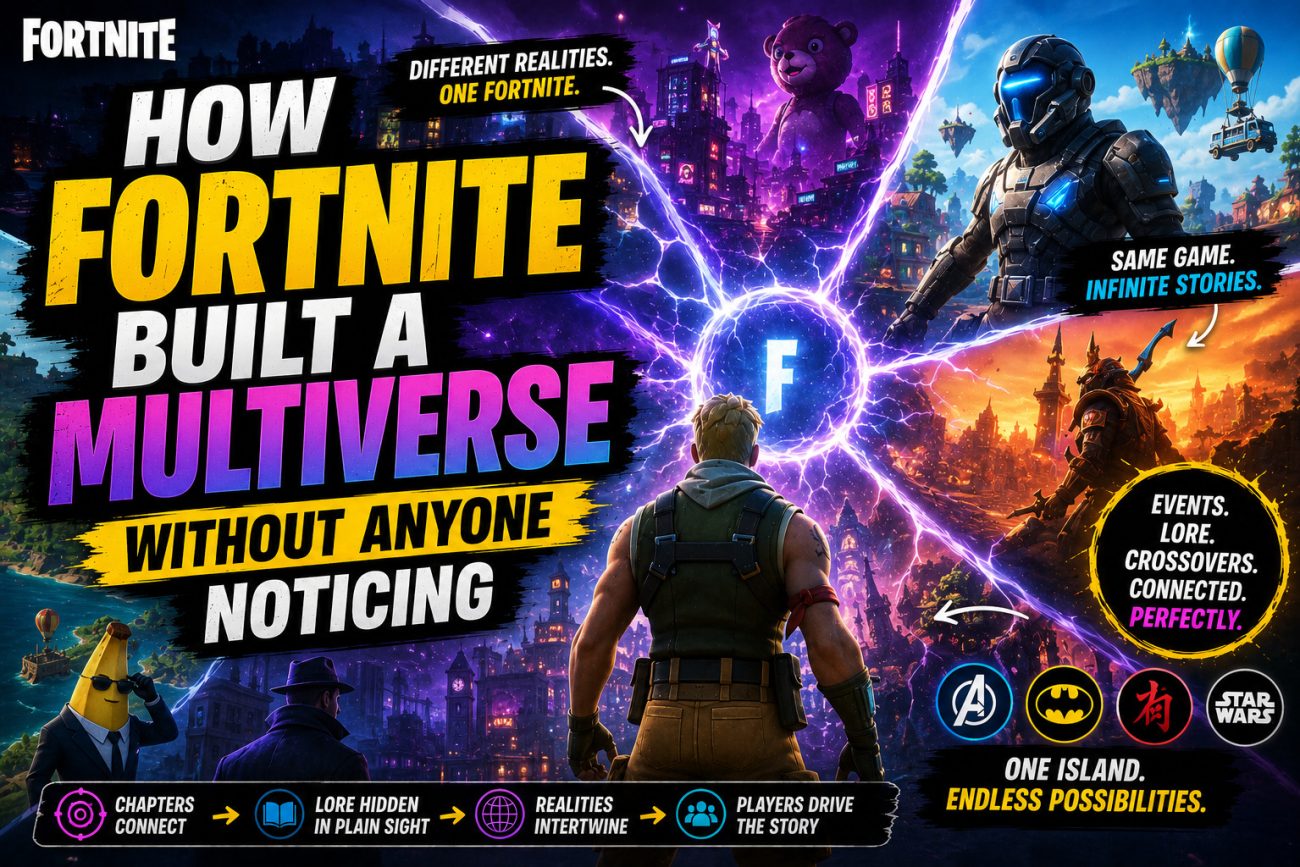
Fortnite started as a colorful battle royale where players landed on an island, collected weapons, built structures, and fought until one player or team remained.
Over time, however, Fortnite became something much bigger.
The island began changing.
Strange portals appeared. Characters from different realities arrived. The Zero Point became central to the story. Entire locations disappeared or transformed, while characters from different worlds began appearing together.
Eventually, it became clear that Fortnite wasn’t simply telling a story about one island.
It was building a multiverse.
What makes Fortnite’s approach particularly interesting is that this development happened gradually. Instead of introducing the entire concept at once, Epic Games expanded the game’s universe through seasons, live events, characters, locations, collaborations, and major changes to the island.
This article explores how Fortnite developed that larger multiverse and why it became such an important part of the game’s identity.
Fortnite Wasn’t Always About the Multiverse
Early Fortnite storytelling was relatively simple.
Players were primarily concerned with the island, the mysterious meteor, and the strange events happening around them.
There wasn’t initially a clear explanation for why the island kept changing.
Then things started getting stranger.
A rocket launched.
Rifts appeared.
Objects began moving between locations and, eventually, between realities.
The game’s story gradually shifted from a straightforward island mystery into something much larger.
The Rocket Launch Changed Everything
One of the earliest major clues came from the rocket launch in Chapter 1.
Players gathered around the launch site and watched the rocket take off.
Instead of simply disappearing into the sky, the rocket created a massive rift.
This introduced an important concept:
Reality in Fortnite could be manipulated.
The rifts became a recurring storytelling device.
They allowed Fortnite to introduce strange objects, characters, and eventually concepts that didn’t necessarily belong to the original island.
This was an important foundation for the multiverse that Fortnite would eventually develop.
The Butterfly Event and the Zero Point
Another important moment came with the Butterfly event.
Players were transported into a mysterious dimension before returning to the island.
The event helped establish that Fortnite’s world contained spaces and phenomena beyond the ordinary map.
Over time, this mysterious reality became connected to the Zero Point.
The Zero Point became one of the most important concepts in Fortnite’s storyline.
What Is the Zero Point?
The Zero Point is essentially one of the central elements connecting Fortnite’s different realities.
It has been portrayed as an incredibly powerful source of energy connected to reality itself.
Its importance became increasingly clear as Fortnite’s story expanded.
The Zero Point could be:
- Manipulated
- Protected
- Exploited
- Destabilized
- Connected to different realities
This made it a convenient narrative mechanism for explaining why characters and locations from different worlds could appear in Fortnite.
The Island Isn’t Just One Island
One of the biggest misconceptions about Fortnite’s map is that every version is simply a completely unrelated island.
Instead, Fortnite’s storyline has repeatedly connected different versions of the island through larger reality-based concepts.
The island can change.
It can be destroyed.
It can be rebuilt.
It can be transported.
It can even be connected to other realities.
This is one reason Fortnite can repeatedly introduce major changes without completely abandoning its previous story.
The Loop
Another major part of Fortnite’s story is the Loop.
Players repeatedly enter the Battle Royale experience.
Characters can fight, return, and repeat the cycle.
This isn’t simply a gameplay convenience.
Within Fortnite’s story, the Loop became an actual narrative concept.
Characters trapped inside it experience a strange cycle where events repeatedly occur.
This helped Fortnite explain one of the game’s fundamental gameplay mechanics through its lore.
Every match wasn’t necessarily just a match.
It could be interpreted as another cycle within the Loop.
The Imagined Order
The multiverse story became much more complicated with the introduction of the Imagined Order, commonly known as the IO.
The organization had a major interest in controlling the Zero Point and maintaining order across realities.
The IO introduced a much larger conflict.
Instead of the story being:
“What’s happening to this island?”
the question became:
“Who controls reality itself?”
That dramatically expanded the scale of Fortnite’s narrative.
The Seven
Opposing the Imagined Order was another major group known as The Seven.
The Seven became some of Fortnite’s most important characters.
Their goal was closely connected to breaking the Loop and challenging the IO.
Characters such as:
- The Foundation
- The Scientist
- The Visitor
- The Origin
- The Paradigm
- The Imagined
- The Order
helped develop Fortnite’s larger storyline.
The conflict between The Seven and the IO eventually became one of the game’s major narrative arcs.
The Zero Point Connects Different Realities
Once Fortnite’s story established the importance of the Zero Point, collaborations began to make much more narrative sense.
Characters that appeared to come from completely different franchises could be presented as visitors from other realities.
This created a flexible explanation for Fortnite’s increasingly diverse cast.
Instead of asking:
“Why is this character in Fortnite?”
the story could effectively answer:
“They came from another reality.”
That simple concept opened enormous creative possibilities.
Fortnite’s Crossover Era
Fortnite became famous for collaborations with major entertainment franchises.
Players have seen characters and themes connected to properties including:
- Marvel
- DC
- Star Wars
- Dragon Ball
- The Walking Dead
- Stranger Things
- Transformers
- Resident Evil
- Teenage Mutant Ninja Turtles
And many more.
Not every collaboration necessarily represents a permanent piece of the central storyline.
However, Fortnite’s multiverse concept provides a framework that makes these crossovers feel more natural within the game’s universe.
Marvel and the Multiverse
The Marvel crossover was particularly important.
During Chapter 2 Season 4, Fortnite’s island became the setting for Nexus War.
Characters such as Thor, Iron Man, Wolverine, Storm, Doctor Doom, and other Marvel characters appeared.
The season culminated in the Galactus event.
This was a major demonstration of Fortnite’s ability to combine its own storyline with another fictional universe.
Galactus
Galactus represented a threat far larger than a typical Fortnite villain.
The event transformed the Battle Bus into a weapon and placed players directly inside the battle.
The scale of the event helped reinforce one of Fortnite’s central ideas:
Its story could operate on a reality-spanning scale.
The island was no longer isolated.
It could interact with worlds far beyond it.
The Batman Connection
DC characters also became part of Fortnite’s increasingly complicated universe.
Batman was brought into Fortnite through crossover content and later received an especially significant storyline in Batman/Fortnite: Zero Point.
The comic series connected Batman and other DC characters with Fortnite’s mysterious island and Loop.
This was important because the connection wasn’t limited to a cosmetic skin.
Fortnite’s concepts were being incorporated into a larger narrative.
The Zero Point Comics
The Batman/Fortnite: Zero Point comic series helped expand Fortnite’s lore beyond the game itself.
The story explored Batman’s experience with the Loop and the strange reality surrounding Fortnite.
This demonstrated that Fortnite’s universe wasn’t restricted to the Battle Royale map.
The story could exist across:
- Games
- Comics
- Cinematic events
- Characters
- Seasonal narratives
This is one of the reasons Fortnite’s lore became much more complicated than it initially appeared.
Fortnite’s Reality Is Constantly Changing
Another important part of Fortnite’s multiverse is the constant transformation of its world.
The island has gone through enormous changes.
Locations have appeared and disappeared.
Maps have been replaced.
Characters have changed sides.
Entire chapters have ended.
The story uses these transformations to create a sense that Fortnite exists in a constantly evolving reality.
The End and the Black Hole
The end of Chapter 1 was one of the clearest examples.
The island was destroyed.
Players were left looking at a black hole.
For a period of time, Fortnite essentially stopped being the Fortnite players knew.
Then Chapter 2 began.
This event established that Fortnite could completely destroy and replace its own world.
That made future transformations much easier to accept.
Chapter Changes Became Part of the Story
In many games, a map change is simply a map update.
In Fortnite, map changes frequently became part of the narrative.
A new chapter wasn’t merely:
“Here’s a new map.”
It could be:
“Reality has changed.”
That distinction helped Fortnite turn live-service updates into storytelling events.
Characters Became More Important
As the story developed, Fortnite moved away from having a simple collection of mysterious characters.
Characters started developing:
- Motivations
- Alliances
- Conflicts
- Backstories
- Relationships
- Different versions across realities
This gave the Fortnite universe more depth.
The Foundation, for example, became much more than a cosmetic character.
He became one of the major figures in the conflict surrounding the Zero Point and the IO.
Fortnite Doesn’t Treat Every Reality the Same
One important detail is that Fortnite’s multiverse isn’t necessarily a collection of completely independent universes that never interact.
Instead, Fortnite’s story frequently suggests a network of realities connected through larger concepts.
The Zero Point, rifts, and other reality-related phenomena provide ways for these worlds to interact.
This allows Fortnite to introduce radically different locations and characters while maintaining a broader narrative framework.
Why Collaborations Fit Fortnite So Well
This is one of the biggest reasons Fortnite became such a successful crossover platform.
Most fictional universes have strict rules.
A superhero belongs in one franchise.
A movie character belongs in another.
A video game character belongs somewhere else.
Fortnite’s multiverse makes these boundaries much easier to cross.
A character can simply be interpreted as originating from another reality.
That doesn’t necessarily mean every collaboration is canon in exactly the same way.
Some crossovers are primarily promotional.
Others are more deeply integrated into the story.
The distinction matters.
Not Every Skin Is Automatically Lore
Just because a character has a Fortnite skin doesn’t necessarily mean they are an important part of the central storyline.
Fortnite frequently uses collaborations for:
- Promotions
- Events
- Cosmetics
- Marketing
- Entertainment
Players shouldn’t assume that every crossover has equal narrative importance.
This is an important distinction when discussing Fortnite’s lore.
Fortnite’s Multiverse Makes the Game Flexible
The biggest advantage of the multiverse concept is flexibility.
Epic can introduce almost anything.
A new season can involve:
- Ancient mythology
- Superheroes
- Aliens
- Monsters
- Futuristic technology
- Famous musicians
- Movie characters
- Fantasy worlds
The story doesn’t necessarily need to completely rebuild its foundation every time.
The multiverse provides an overarching explanation for why Fortnite can keep changing.
Why Players Didn’t Notice the Bigger Picture Immediately
The multiverse wasn’t introduced as one giant explanation.
Instead, Fortnite revealed pieces gradually.
First came strange events.
Then rifts.
Then the Zero Point.
Then the Loop.
Then organizations such as the IO and The Seven.
Then major crossovers.
Then increasingly complex reality-based storylines.
Looking back, these elements form a much clearer picture.
Fortnite wasn’t suddenly creating a multiverse.
It was building one piece by piece.
Fortnite’s Storytelling Is Different From Traditional Games
Traditional games often tell a story through:
- Cutscenes
- Dialogue
- Missions
- Cinematics
Fortnite uses these methods too, but its live-service structure gives it another tool:
The game world itself can change.
A story event can physically alter the map.
A character can appear in the world.
A location can disappear.
A new chapter can replace the previous reality.
That makes the player feel like they’re witnessing the story rather than simply watching it.
The Biggest Strength of Fortnite’s Multiverse
The greatest strength isn’t simply allowing crossover characters.
It’s giving Fortnite infinite room to evolve.
If Fortnite remained tied to one island and one cast of characters, the story would eventually become difficult to expand.
The multiverse removes many of those limitations.
A new story can introduce an entirely different setting without completely breaking the existing universe.
The Biggest Problem With the Multiverse
There is also a downside.
Fortnite’s lore can become extremely difficult for new players to understand.
Someone who started playing recently may encounter terms such as:
- Zero Point
- Zero War
- Loop
- Imagined Order
- The Seven
- Reality Zero
- Zero Fusion
- The Last Reality
without understanding how they connect.
The sheer number of events and collaborations can make Fortnite’s story intimidating.
Is Fortnite’s Entire Multiverse Canon?
Not necessarily in a simple sense.
Fortnite’s storytelling contains different types of content.
Some elements are clearly central to the storyline.
Others are crossover or promotional content.
Some collaborations have stronger narrative connections than others.
Therefore, it’s better to think of Fortnite as having a multiverse framework rather than assuming every single skin or collaboration is equally important to the central plot.
Why Fortnite’s Multiverse Matters
Fortnite’s multiverse isn’t just an excuse for collaborations.
It has become a storytelling tool.
It explains how the game can constantly reinvent itself while retaining recognizable concepts such as:
- The Island
- The Loop
- The Zero Point
- Major characters
- Reality-based conflicts
It also allows Fortnite to connect its own story with completely different fictional worlds.
That combination is extremely unusual.
Final Thoughts
Fortnite’s multiverse wasn’t created overnight.
It developed gradually through years of mysterious events, reality changes, characters, organizations, crossovers, and live experiences.
The rocket launch introduced the idea that Fortnite’s world could behave in unexpected ways.
Rifts expanded that idea.
The Zero Point provided a central connection between realities.
The Loop turned the game’s repetitive Battle Royale structure into part of its narrative.
The IO and The Seven expanded the conflict.
And major crossovers demonstrated how far Fortnite’s universe could reach.
Today, Fortnite is much more than the island players originally knew.
Its story has become a constantly changing collection of realities, characters, and worlds.
And that’s perhaps the most impressive part of Fortnite’s storytelling:
The game didn’t need to explain the entire multiverse at once.
It let players discover it one mystery at a time.
Frequently Asked Questions
Does Fortnite have a multiverse?
Fortnite’s storyline includes multiple realities connected through concepts such as the Zero Point and rifts. This framework has allowed characters and locations from different fictional worlds to appear within Fortnite.
What is the Zero Point in Fortnite?
The Zero Point is one of the central concepts in Fortnite’s lore and is closely associated with reality and the connections between different worlds.
What is the Loop in Fortnite?
The Loop is a recurring cycle within Fortnite’s storyline. It also provides a narrative explanation for the repeated Battle Royale experience.
Are Marvel and DC characters part of Fortnite’s multiverse?
Fortnite has officially collaborated with both Marvel and DC. However, individual crossover characters and events can have different levels of connection to the main storyline.
Why does Fortnite keep changing its map?
Map changes are part of Fortnite’s live-service design and have frequently been connected to the game’s evolving story. Major events can introduce new locations, destroy existing ones, or transition the game into a new chapter.
Is every Fortnite crossover canon?
Not necessarily. Some collaborations are primarily promotional or cosmetic, while others are more closely connected to Fortnite’s storyline.
Who controls the Fortnite multiverse?
There isn’t a simple answer. Different organizations and characters have attempted to control or manipulate reality, particularly around the Zero Point. The story has changed significantly across Fortnite’s chapters and seasons.
Why does Fortnite use so many crossover characters?
The multiverse concept gives Fortnite a flexible framework for bringing characters from different fictional worlds into the game, although not every collaboration needs to be treated as equally important to the central lore.
