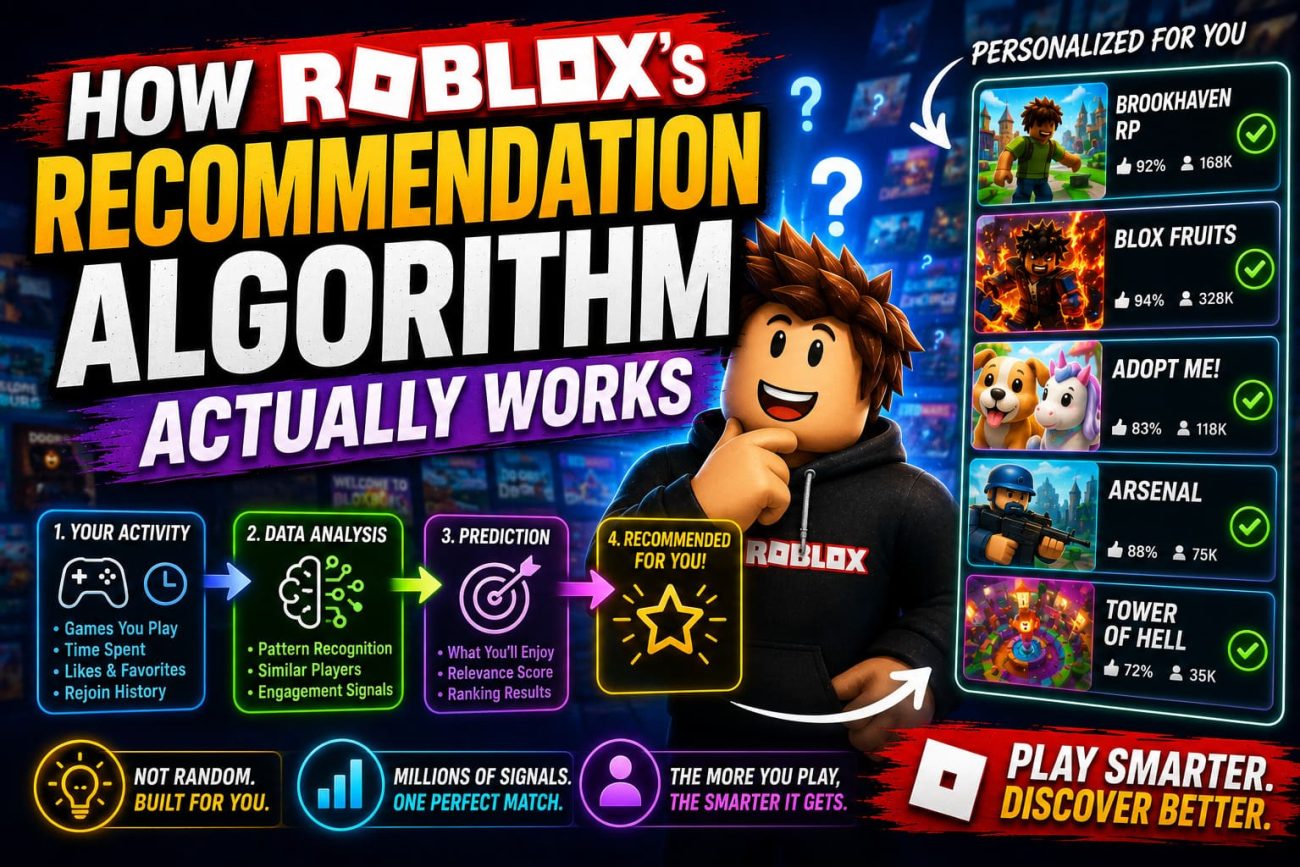
If you’ve ever wondered why one Roblox experience suddenly starts attracting thousands of players while another similar experience struggles to get discovered, the answer is partly connected to Roblox’s recommendation systems.
Roblox does not simply show every player the same list of experiences. The platform uses personalized discovery systems to help players find experiences they may be interested in based on different signals and their previous activity.
For Roblox developers, understanding these systems can be useful because creating a great game is only one part of growing an experience. Players also need to discover it, click on it, play it, and continue coming back.
This guide explains how Roblox recommendations work, what signals developers should pay attention to, and what you can do to improve the chances of your experience being discovered.
Important: Roblox does not publicly reveal every detail of its recommendation algorithms. The exact ranking formulas can change, so the strategies below should be treated as practical guidance rather than a guaranteed formula for getting recommended.
What Is the Roblox Recommendation Algorithm?
The Roblox recommendation system is designed to help players discover experiences that may be relevant or interesting to them.
Instead of presenting exactly the same experiences to every user, Roblox can personalize discovery based on factors such as player behavior, experience performance, engagement, and other signals.
This means that two players can potentially see different experiences in discovery areas.
For developers, this creates an important distinction:
Getting an impression is not the same as getting a player.
Your experience may be shown to someone, but if they don’t click or don’t enjoy the experience after joining, continued discovery can become difficult.
How Roblox Discovery Works
Players can discover experiences through several parts of the Roblox platform.
Depending on the current Roblox interface, discovery can involve:
- Home recommendations
- Search
- Charts and rankings
- Categories
- Friends and social activity
- Personalized recommendations
- Direct links
- External traffic
The exact appearance and placement of these discovery surfaces can change over time.
The important point is that developers shouldn’t think of “the Roblox algorithm” as a single button or ranking system.
Different discovery surfaces can work differently.
1. Player Interest Matters
One of the most important concepts behind personalized recommendations is player interest.
If a player frequently interacts with a particular type of experience, Roblox has more information about what that player may enjoy.
For example, someone who regularly plays:
- Obby games
- Role-playing experiences
- Horror games
- Racing games
- Simulator experiences
may receive recommendations influenced by those interests.
This is why an experience doesn’t necessarily need to appeal to every Roblox player.
It needs to provide a compelling experience for the audience it is targeting.
2. Player Engagement Is Important
Getting players to click on your experience is only the beginning.
Once players enter, their behavior can provide information about how engaging the experience is.
Useful engagement concepts include:
- How long players stay
- Whether they return
- Whether they interact with the game
- Whether they leave immediately
- Whether they play with friends
- Whether they continue progressing
Roblox does not publicly provide a simple formula such as:
“Playtime × clicks = recommendation score.”
So developers should avoid treating any single metric as a guaranteed ranking factor.
Instead, think about the overall player experience.
If people consistently join your game and leave after a few seconds, improving the thumbnail alone probably won’t solve the underlying problem.
3. Retention Can Be a Valuable Indicator
Retention describes whether players return to an experience after their initial visit.
Imagine two experiences receive similar amounts of traffic.
Experience A gets players to join but most leave quickly and never return.
Experience B gets fewer initial players, but many players return repeatedly.
The second experience demonstrates stronger evidence that it is providing ongoing value to its audience.
For developers, this means the goal shouldn’t simply be:
“Get someone to click.”
A better goal is:
“Get the right player to click, enjoy the experience, and want to return.”
4. Click-Through Rate Matters to Your Growth Strategy
Your experience’s presentation can affect whether someone chooses to click it.
Important elements include:
- Experience title
- Thumbnail
- Icon
- Description
- Screenshots or promotional visuals
- Clear explanation of the gameplay
A strong thumbnail can attract attention.
But there is an important warning:
Don’t use misleading thumbnails.
If the thumbnail promises something the experience doesn’t actually provide, players may click but leave quickly.
That can create a poor experience for users and doesn’t solve the underlying retention problem.
Your presentation should accurately communicate what players will find after joining.
5. The First Few Minutes Matter
The beginning of your experience is extremely important.
A new player should quickly understand:
- What the game is about
- What they are supposed to do
- How to control the game
- What their immediate objective is
- Why they should continue playing
Avoid overwhelming new players with complicated menus and instructions.
A simple onboarding experience can make it easier for players to understand the game’s core loop.
Example
Instead of showing a player five different menus immediately, you could guide them through:
Spawn → Tutorial → First objective → Reward → Next objective
The player should understand the purpose of the game quickly.
6. Your Core Gameplay Loop Matters
A successful Roblox experience usually gives players a reason to continue.
A simple gameplay loop might look like:
Play → Earn → Upgrade → Unlock → Play again
Another experience might use:
Explore → Discover → Complete challenge → Receive reward → Explore again
The exact loop depends on the genre.
The important thing is that players should understand what they’re working toward.
If the gameplay becomes repetitive without meaningful progression, retention can suffer.
7. Returning Players Are Valuable
A player who returns to your experience has demonstrated more interest than someone who visits once and disappears.
You can encourage legitimate return visits by providing:
- New content
- Progression
- Challenges
- Events
- Achievements
- Social features
- Meaningful rewards
- Regular improvements
Don’t rely entirely on artificial tricks such as forcing players to stay online.
The objective should be to give players a genuine reason to return.
8. Friends Can Influence Discovery
Roblox is strongly connected to social gameplay.
Players may discover experiences because their friends are playing them or because an experience provides a compelling reason to play together.
For multiplayer developers, social features can therefore be particularly valuable.
Consider mechanics such as:
- Party play
- Cooperative objectives
- Team-based challenges
- Shared progression
- Multiplayer events
- Friend invitations
A game that becomes more enjoyable with friends can naturally encourage additional players to join.
9. Search Optimization Is Different From Recommendations
Roblox discovery isn’t limited to personalized recommendations.
Search is another important way players can find experiences.
This means your title and description should clearly explain what your experience actually is.
For example, if your game is a racing experience, players should be able to understand that from the title and description.
Avoid stuffing your description with unrelated keywords.
Good approach
Use natural language that explains:
- Genre
- Main gameplay
- Features
- Unique mechanics
- Multiplayer options
Poor approach
Repeating dozens of unrelated popular keywords simply because you think they will generate traffic.
The first approach is better for both users and discoverability.
10. The Experience Icon Matters
Your icon is often one of the first visual elements a player sees.
A strong icon should communicate the game’s identity quickly.
It should:
- Be visually clear
- Represent the actual game
- Remain recognizable at small sizes
- Avoid unnecessary clutter
- Match the experience’s theme
Your icon shouldn’t promise something that doesn’t exist inside the game.
Consistency between your icon, thumbnail, title, and actual gameplay creates a more trustworthy presentation.
11. Thumbnails Can Affect Player Behavior
A thumbnail has one major job:
Make the right player interested enough to investigate the experience.
Good thumbnails generally communicate an idea quickly.
For example, instead of showing a random screenshot with tiny text, highlight the main gameplay feature.
If your game is about surviving waves of enemies, show the player fighting a large wave.
If it is a racing game, show the race.
If it is an adventure game, show the world or a memorable gameplay moment.
12. Don’t Chase Every Trend
Trends can bring temporary attention, but building an experience around a trend that doesn’t match your game can attract the wrong audience.
Suppose a particular Roblox genre becomes popular.
You copy its thumbnail style and title but your actual game offers something completely different.
Players may click and quickly leave.
A better strategy is to identify trends that genuinely fit your experience and adapt them without losing your game’s identity.
13. Update Your Experience
A game that never changes can eventually lose player interest.
Updates don’t always have to be massive.
You can improve an experience by adding:
- New maps
- New challenges
- New items
- Balance improvements
- Bug fixes
- New progression
- Quality-of-life features
- Seasonal content
More importantly, updates should solve actual player problems or provide something players want.
Adding content simply to claim that your game was “updated” doesn’t automatically create a better experience.
14. Fix Bugs Before Adding Features
A common development mistake is continuously adding new features while ignoring existing problems.
Imagine a game has:
- Long loading times
- Frequent crashes
- Confusing controls
- Broken quests
- Poor mobile performance
Adding another cosmetic item won’t fix the underlying experience.
Prioritize stability and usability.
A smooth game can create a stronger foundation for growth.
15. Mobile Players Matter
Roblox is played across multiple devices.
Your experience should be tested on the devices your target audience uses.
Pay particular attention to:
- Touch controls
- Button size
- UI readability
- Performance
- Loading time
- Camera controls
- Screen layout
A game that works perfectly on a powerful PC but is frustrating on mobile can lose a significant portion of potential players.
16. Don’t Try to Manipulate the Algorithm
There is a major difference between optimizing your game and attempting to manipulate a recommendation system.
Avoid strategies such as:
- Fake players
- Artificial engagement
- Misleading thumbnails
- Spam
- Fake reviews
- Bots
- Purchased engagement
- Exploitative traffic schemes
These tactics don’t create a better game and can put your account or experience at risk.
Instead, focus on real players and genuine engagement.
17. External Traffic Can Help You Test Your Game
Developers can promote their experiences outside Roblox through legitimate channels.
Depending on your audience, this could include:
- YouTube
- TikTok
- Discord communities
- Social media
- Gaming websites
- Creator collaborations
External traffic can be particularly useful for testing whether your game’s presentation converts interested users into actual players.
However, sending large amounts of irrelevant traffic isn’t necessarily helpful.
You want people who are genuinely interested in the experience.
18. Analyze Your Player Funnel
One of the most useful ways to improve a Roblox experience is to think about the player journey.
A simplified funnel looks like:
Impression → Click → Join → Play → Return
If players see your experience but don’t click, your presentation may need improvement.
If they click but leave immediately, the experience itself may need work.
If they play but don’t return, you may need to improve progression, content, or long-term engagement.
This way of thinking is much more useful than simply asking:
“Why isn’t Roblox recommending my game?”
19. Improve One Problem at a Time
Don’t completely redesign your game after every disappointing result.
Instead, identify the biggest problem.
For example:
Problem: Players leave immediately.
Possible focus:
Improve onboarding.
Problem: Players join but don’t understand the objective.
Possible focus:
Improve tutorials and UI.
Problem: Players enjoy the first session but don’t return.
Possible focus:
Improve progression and replayability.
Problem: Players don’t click the experience.
Possible focus:
Improve title, icon, thumbnail, and positioning.
This creates a much more systematic development process.
A Simple Roblox Growth Checklist
Before trying to increase traffic, make sure your experience has:
- A clear concept
- An understandable title
- An accurate icon
- Strong thumbnails
- A clear description
- A simple onboarding experience
- Fun core gameplay
- Meaningful progression
- Stable performance
- Mobile-friendly controls
- Few major bugs
- Reasons for players to return
- Social or multiplayer features where appropriate
- Regular improvements
What Developers Should Focus On
Instead of asking:
“How do I trick the Roblox algorithm?”
ask:
“How can I make the right players enjoy my game?”
That change in mindset is important.
A recommendation system ultimately needs to help players discover experiences they are likely to enjoy.
Your job as a developer is to make your experience worth recommending by creating something that attracts the appropriate audience and provides a good experience after they arrive.
Final Thoughts
Roblox’s recommendation systems aren’t a simple formula that developers can copy and paste.
The exact algorithms are not completely public, and Roblox can change how discovery works over time.
However, developers can focus on the things they can control:
Create a good experience → attract the right audience → provide a strong first session → encourage genuine engagement → improve based on player behavior.
Your title, icon, thumbnails, onboarding, gameplay loop, performance, social features, updates, and retention all contribute to the overall quality of your experience.
Rather than searching for a secret algorithm trick, build an experience that players actually want to discover, play, and return to.
Frequently Asked Questions
Does Roblox have one recommendation algorithm?
Not necessarily. Roblox has multiple discovery surfaces and systems, and the exact ranking methods can differ. The platform does not publicly disclose every detail of its recommendation systems.
How do I get my Roblox game recommended?
There is no guaranteed method. Focus on creating a quality experience, attracting the right audience, improving player engagement and retention, and maintaining accurate titles, thumbnails, and descriptions.
Does player retention matter on Roblox?
Retention is an important metric for understanding whether players find your experience worth returning to. Developers should monitor returning-player behavior alongside other performance indicators.
Do Roblox thumbnails matter?
Thumbnails are an important part of presenting your experience to potential players. A clear, accurate thumbnail can help communicate what your game offers and encourage the right audience to investigate it.
Can I pay for players to boost my Roblox game?
Artificial engagement is not a good long-term growth strategy. Focus on genuine players who are actually interested in your experience rather than attempting to manipulate discovery systems.
Should I update my Roblox game frequently?
Regular improvements can help keep an experience fresh, but quality is more important than publishing meaningless updates. Focus on useful content, bug fixes, performance, and improvements that benefit players.
How can I tell why my Roblox game isn’t growing?
Look at the complete player journey. If users aren’t clicking, improve your presentation. If they leave quickly, improve onboarding and gameplay. If they play once but don’t return, work on progression, replayability, and long-term value.
