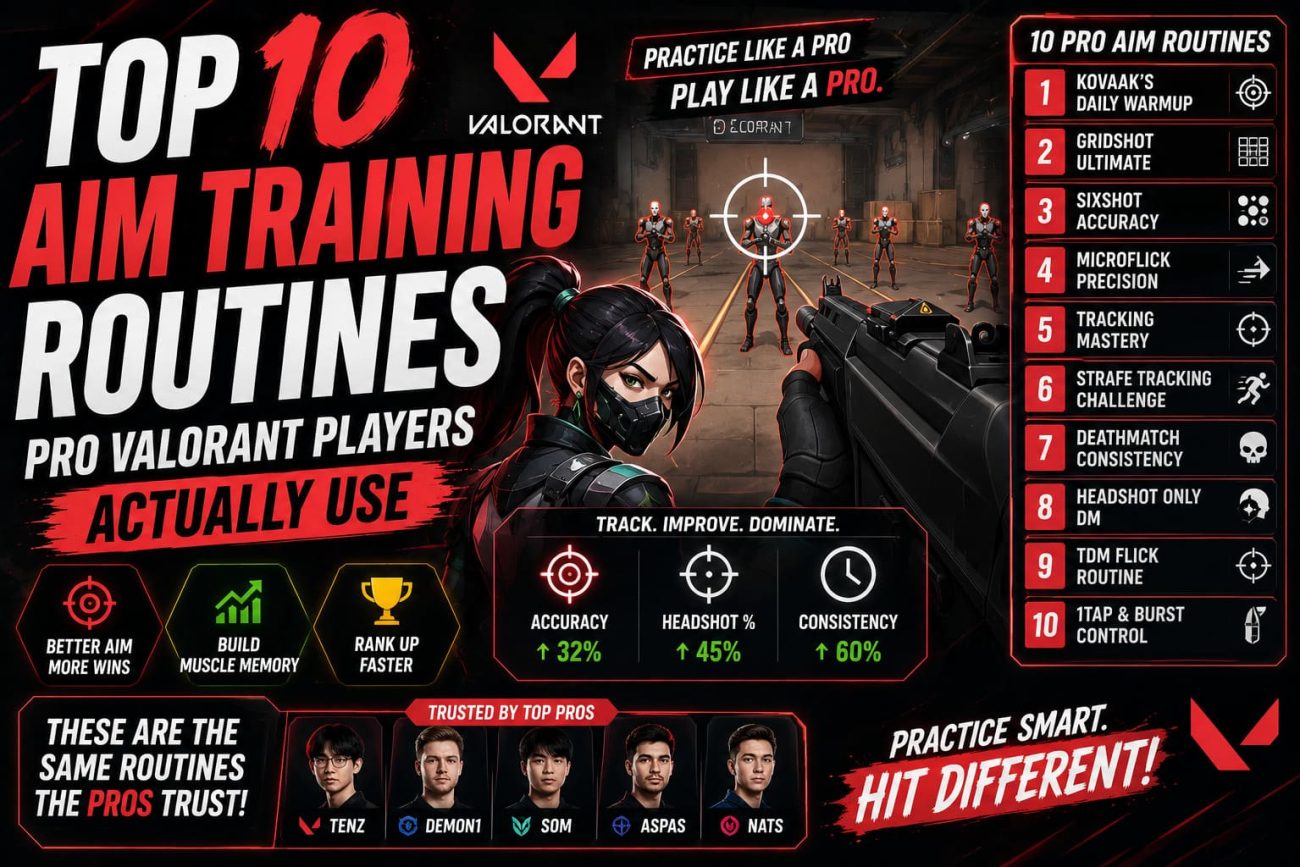
Good aim in VALORANT isn’t developed by simply playing more ranked matches.
Strong players deliberately practice different parts of their gunplay, including crosshair placement, flicking, tracking, recoil control, reaction speed, movement, and first-shot accuracy.
Professional players don’t all follow exactly the same warm-up routine. Some spend time in the Range, others use Deathmatch or Team Deathmatch, and many combine several exercises depending on what they want to improve.
The most important idea is consistency.
A focused 20–30 minute practice session can be more useful than spending an hour mindlessly shooting targets.
This guide covers 10 practical aim-training routines that VALORANT players can use to improve their mechanics.
Important: There is no single official “pro aim routine.” The routines below combine common competitive practice methods with VALORANT’s built-in training modes. Treat them as adaptable training ideas rather than claiming every professional player follows the exact same schedule.
Why Aim Training Matters in VALORANT
VALORANT is a tactical shooter where accurate gunplay is extremely important.
Riot describes the game as a 5v5 tactical shooter centered on gunplay and agent abilities, with one life per round in the standard format.
Because you often have only one life in a round, winning the first gunfight can have a major impact on the round.
Aim training can help you develop:
- Better crosshair placement
- Faster reactions
- More consistent flicks
- Better target tracking
- Improved recoil control
- More confident shooting
- Better movement discipline
- More consistent first-shot accuracy
However, aim isn’t the only skill that determines your rank.
Positioning, game sense, utility usage, communication, and decision-making are equally important parts of becoming a better VALORANT player.
1. Static Target Accuracy Drill
One of the simplest ways to warm up is to practice shooting stationary targets.
Go into The Range and focus on accuracy rather than speed.
The goal is not to see how quickly you can eliminate every target.
Instead, concentrate on placing your crosshair correctly before firing.
How to practice
Start with:
- A basic rifle
- Stationary targets
- Controlled single shots
Aim at the head.
Fire.
Move to the next target.
Repeat.
What this improves
This drill helps develop:
- Crosshair placement
- Precision
- First-shot accuracy
- Mouse control
Once your accuracy becomes consistent, gradually increase your speed.
Don’t Chase Speed Too Early
A common mistake is immediately trying to flick between targets as quickly as possible.
If your accuracy drops dramatically, slow down.
The goal is to build reliable mechanics first.
2. Headshot-Only Practice
Headshots are extremely important in VALORANT.
A useful practice method is to intentionally focus on head-level aiming.
Instead of shooting at the body whenever you see a target, train yourself to place your crosshair at head height.
Practice method
Move between targets while keeping your crosshair around the expected head level.
Then:
Spot target → adjust → fire
Avoid unnecessary mouse movement.
Why this matters
Good crosshair placement reduces the amount of adjustment required when an enemy appears.
Instead of moving your crosshair from the body toward the head, you are already close to the correct position.
3. Micro-Flick Training
A micro-flick is a small, controlled movement of your crosshair from one position to another.
You use this constantly during real matches.
An enemy may appear slightly away from your crosshair.
You need to make a small correction and fire.
How to practice
Place your crosshair near a target.
Move slightly away.
Flick back toward the head.
Shoot.
Repeat from different starting positions.
Focus on control
These shouldn’t be huge movements.
You’re training precision.
Small, accurate corrections are often more useful in real matches than practicing only enormous flicks.
4. Large Flick Training
Large flicks are another useful mechanical skill.
They involve quickly moving your crosshair across a larger portion of the screen to reach a target.
Practice
Place several targets around your field of view.
Choose one.
Move your crosshair quickly toward it.
Stop on the target.
Fire.
Then choose another target.
Important rule
Don’t immediately prioritize maximum speed.
A good flick should end with your crosshair under control.
If you’re constantly overshooting targets, reduce your speed and focus on stopping accurately.
5. Strafing and Shooting Drill
Aiming isn’t only about keeping your mouse steady.
Your movement affects your accuracy too.
Practice moving from side to side and stopping before taking your shot.
A simple sequence is:
Strafe → stop → aim → shoot → move
This teaches you to separate movement from accurate shooting.
Why this matters
In real matches, standing completely still makes you vulnerable.
You need to move while maintaining the ability to stop and fire accurately.
Practicing this relationship between movement and shooting can make your gunfights more consistent.
6. Deathmatch Warm-Up
VALORANT’s Deathmatch mode was specifically introduced as a way for players to practice gunplay and warm up before ranked matches. Riot’s original Deathmatch implementation was designed around repeated gunfights without abilities.
Instead of treating every Deathmatch as a competition, use some matches as mechanical practice.
Focus on:
- Crosshair placement
- Headshots
- Strafing
- First-shot accuracy
- Taking clean fights
- Avoiding panic spraying
Don’t worry too much about your final score.
If your goal is aim improvement, a Deathmatch where you deliberately practice good habits can be more valuable than one where you only chase kills.
7. Team Deathmatch Aim Practice
Team Deathmatch provides another way to practice gunfights against real players.
Riot describes Team Deathmatch as a 5v5 mode with frequent respawns and continuous combat.
This makes it useful for players who want more repeated fights without the economy and round structure of standard matches.
What to practice
Use Team Deathmatch to work on:
- Crosshair placement
- Movement
- Weapon control
- Reaction speed
- Taking fights from different angles
Because the mode produces repeated engagements, you can get many opportunities to practice the same mechanical skill.
8. Recoil Control Practice
Not every gunfight ends with a single bullet.
Learning how your weapon behaves during sustained fire can help when you need to control a spray.
Practice method
Choose your weapon.
Fire at a wall.
Observe the bullet pattern.
Then practice controlling the mouse movement to keep your shots closer together.
After that, practice against targets.
Don’t rely entirely on spraying
In many situations, controlled bursts or individual shots can be preferable.
Your goal is to understand when to:
- Tap
- Burst
- Spray
The correct choice depends on weapon, distance, and situation.
9. Crosshair Placement Routine
Crosshair placement is one of the most valuable skills you can practice outside of direct aim drills.
The basic concept is simple:
Keep your crosshair where an enemy’s head is likely to appear.
This reduces the amount of mouse movement required when an opponent swings into your view.
Practice while moving around a map
Instead of looking at the floor while moving, keep your crosshair at approximately head level.
As you approach a corner, position the crosshair where an opponent could appear.
Then clear the angle.
This develops a habit
Eventually, good crosshair placement becomes automatic.
You won’t need to consciously remind yourself every second.
10. The “One Skill Per Session” Routine
This may be the most useful routine for long-term improvement.
Instead of trying to improve everything simultaneously, choose one mechanical skill.
For example:
Session 1
Focus on crosshair placement.
Session 2
Focus on first-shot accuracy.
Session 3
Focus on movement and stopping.
Session 4
Focus on micro-flicks.
Session 5
Focus on recoil control.
Session 6
Focus on Deathmatch gunfights.
Session 7
Combine everything during normal games.
This approach makes it easier to identify what is actually improving.
A 20-Minute VALORANT Aim Routine
You don’t need to spend an hour warming up before every ranked session.
A simple 20-minute routine can be enough.
Minutes 1–5: Precision
Use The Range.
Focus on stationary targets.
Prioritize accuracy.
Minutes 6–10: Flicks
Practice moving between targets.
Start slowly.
Gradually increase speed.
Minutes 11–15: Movement
Practice strafing and stopping before shooting.
Focus on clean shots rather than speed.
Minutes 16–20: Deathmatch
Play a short Deathmatch and concentrate on the skill you practiced.
This gives you a transition from controlled practice into real player interactions.
A 30-Minute Pro-Style Warm-Up
If you have more time, use a longer routine.
5 minutes — Static accuracy
Focus on precise shots.
5 minutes — Flicks
Practice both small and larger crosshair movements.
5 minutes — Movement
Practice strafing, stopping, and shooting.
10 minutes — Deathmatch
Focus on clean gunfights.
5 minutes — Review
Think about what felt inconsistent.
Then take that skill into your next match.
How Often Should You Aim Train?
Consistency matters more than extremely long sessions.
For many players, a short warm-up before playing can be enough.
You could use:
10–15 minutes before casual play.
15–30 minutes before ranked sessions.
Longer dedicated sessions when actively working on a specific mechanical weakness.
You don’t need to spend several hours every day practicing aim.
Overtraining can also make practice less productive if you’re mentally tired.
Don’t Warm Up Until You’re Exhausted
A warm-up should prepare you for playing.
It shouldn’t leave you exhausted before your first ranked game.
If your hands feel tired or your concentration drops, stop.
The purpose of practice is quality.
Quality Beats Quantity
Compare these two approaches:
Player A
Practices 60 minutes while distracted and frustrated.
Player B
Practices 20 minutes with a specific goal.
Player B may get more useful practice despite spending less time.
Common Aim Training Mistakes
1. Focusing Only on Speed
Fast isn’t useful if you’re inaccurate.
2. Ignoring Crosshair Placement
You can have excellent flicks and still lose fights because your crosshair starts in the wrong position.
3. Only Playing Aim Trainers
Aim trainers can be useful, but VALORANT has specific movement, weapon, map, and timing characteristics.
You should eventually transfer your practice into the actual game.
4. Chasing Deathmatch Scores
If you’re training aim, don’t worry about winning every Deathmatch.
Practice the mechanic you’re trying to improve.
5. Changing Sensitivity Constantly
Constantly changing sensitivity makes it difficult to develop consistent mouse control.
Give a setup enough time before deciding that it needs to change.
6. Practicing Without a Goal
Don’t enter The Range and randomly shoot targets for 30 minutes.
Choose a specific objective.
For example:
“Today I’m focusing on keeping my crosshair at head level.”
That gives the session direction.
Aim Training vs. Playing Ranked
Ranked matches are not a replacement for mechanical practice.
During ranked games, you have to think about:
- Economy
- Utility
- Positioning
- Team communication
- Timing
- Rotations
- Enemy tendencies
This mental load means you’re not necessarily focusing entirely on aim.
Training modes allow you to isolate mechanics.
Then ranked games allow you to apply those mechanics in real situations.
Both are valuable.
How to Know if Your Aim Is Improving
Don’t judge improvement from one good game.
Look for longer-term changes.
Ask yourself:
- Am I winning more opening gunfights?
- Is my crosshair staying at head level?
- Am I missing fewer easy shots?
- Am I controlling my movement better?
- Am I panicking less during fights?
- Can I consistently stop before shooting?
- Do my first bullets land more accurately?
Mechanical improvement usually happens gradually.
Keep Your Settings Consistent
Aim training becomes more useful when your environment remains consistent.
Try to avoid changing:
- Mouse sensitivity
- DPI
- Crosshair
- Resolution
- Keybinds
every few days.
Experimenting is fine, but constant changes make it harder to determine whether your practice is actually working.
Build a Routine Around Your Weakness
The best routine for you depends on what you’re struggling with.
If you over-flick
Practice slower precision drills.
If you under-flick
Practice larger controlled movements.
If your crosshair is too low
Spend more time practicing head-level placement.
If you panic spray
Practice controlled bursts and first-shot accuracy.
If you lose movement gunfights
Practice strafing and stopping.
If you struggle against real players
Use Deathmatch or Team Deathmatch to get more live engagements.
Final Thoughts
There isn’t a secret aim routine that instantly turns a player into a professional.
The strongest approach is consistent, focused practice.
Use The Range to isolate mechanics, Deathmatch and Team Deathmatch to practice against real players, and regular matches to apply those skills in actual tactical situations.
Riot has specifically positioned the Range and Deathmatch as tools for learning and warming up gunplay, while Team Deathmatch provides another high-frequency environment for practicing combat.
Start with the fundamentals:
Crosshair placement → precision → movement → flicks → recoil control → real-player practice
You don’t need a complicated two-hour routine.
A focused 20–30 minute session performed consistently can give you a much better foundation than random practice.
Most importantly, don’t measure your progress only by your rank.
If your shots are becoming more consistent, your crosshair placement is improving, and you’re making fewer mechanical mistakes, you’re moving in the right direction.
Frequently Asked Questions
What is the best aim training routine for VALORANT?
There isn’t one universal routine. A combination of Range practice, movement drills, Deathmatch, and real matches provides a good foundation for most players.
Do professional VALORANT players use aim trainers?
Some competitive players use external aim-training software, while others primarily practice inside VALORANT. Individual routines vary, so it is better to choose exercises based on your weaknesses rather than copying a professional player’s routine exactly.
How long should I aim train before ranked?
Around 10–30 minutes is enough for a practical warm-up for many players. You can spend longer on dedicated practice days if you are working on a specific weakness.
Is Deathmatch good for aim training?
Yes. Deathmatch provides repeated gunfights without the normal round structure, making it useful for practicing gunplay and warming up before ranked matches. Riot originally introduced Deathmatch specifically as a way to hone gunplay and warm up.
Should I use The Range every day?
You don’t have to use it every day, but short Range sessions can be useful for warming up and isolating specific mechanical skills.
Should I practice flicking or crosshair placement first?
For most beginners, crosshair placement should come first. Good positioning reduces the amount of flicking you need to do in actual matches.
Can aim training alone make me a high-ranked VALORANT player?
No. Aim is only one part of VALORANT. Game sense, positioning, movement, utility usage, communication, teamwork, and decision-making also have a major impact on performance.
How quickly can aim improve?
Improvement varies from player to player. Consistent practice over weeks is generally more useful than expecting dramatic changes after a few sessions.
