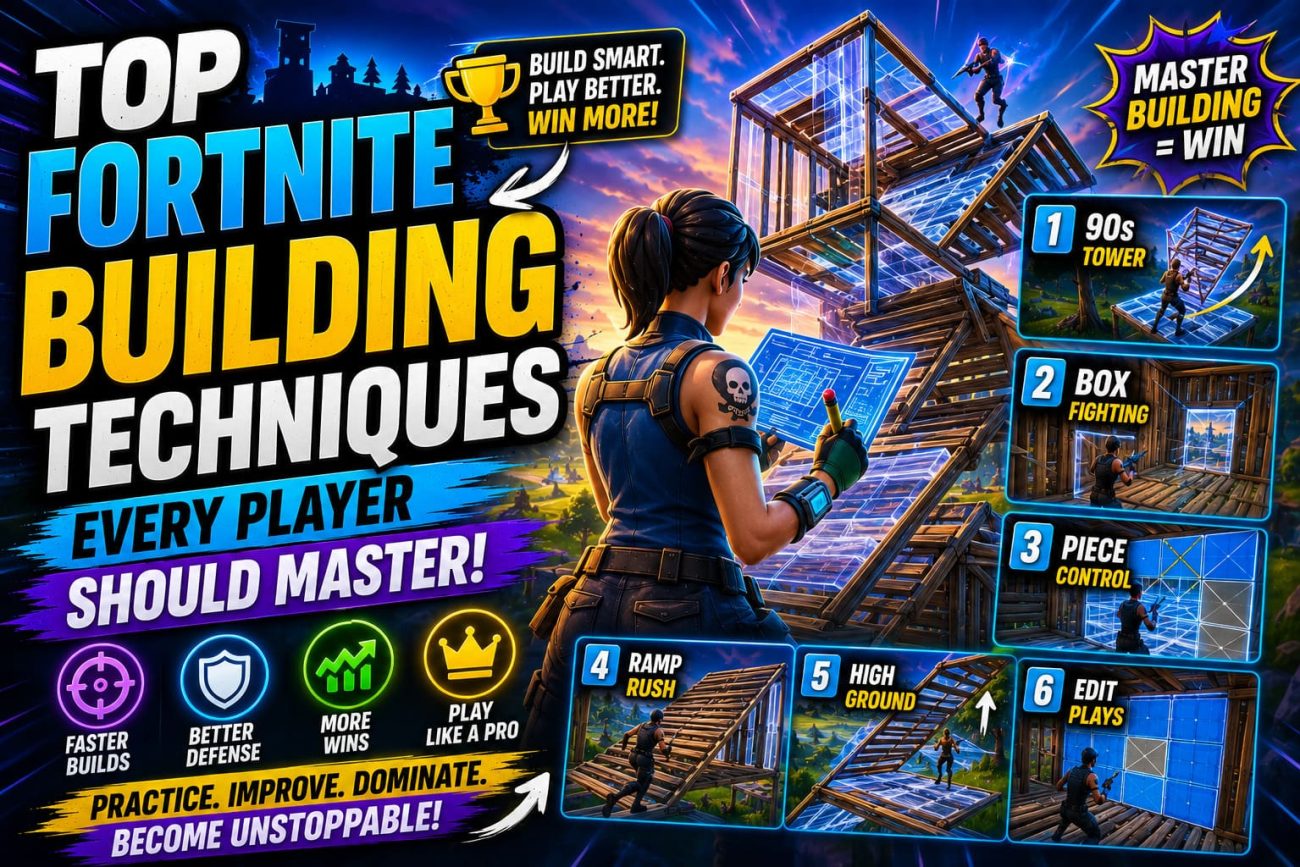
Top Fortnite Building Techniques Every Player Should Master
Building is one of the most important skills in Fortnite’s Build mode. A player with good aim can still lose a fight if they don’t know how to protect themselves, take high ground, or create a better position.
The good news is that you don’t need to master every advanced technique immediately. Learning a small number of reliable building techniques and practicing them consistently can dramatically improve your survival and fighting ability.
This guide covers the most useful Fortnite building techniques every player should learn, from basic defensive walls to more advanced edits and high-ground techniques.
Note: The techniques in this guide apply primarily to Fortnite’s Build mode. Zero Build players can focus instead on positioning, movement, natural cover, and rotations.
Why Building Matters in Fortnite
Building gives you control over the battlefield.
You can use structures to:
- Block incoming shots
- Create cover
- Gain high ground
- Protect yourself while healing
- Reach difficult areas
- Create better angles
- Force opponents into uncomfortable positions
- Escape dangerous situations
The objective isn’t simply to build as much as possible.
Good building is about using the right structure at the right moment.
A player who builds efficiently can often survive an engagement even after taking damage.
1. Learn the Basic Wall
The wall is the foundation of Fortnite building.
When an opponent shoots at you, placing a wall between yourself and the enemy should become an automatic reaction.
Basic defensive wall
The simplest defensive sequence is:
Enemy shoots → place wall → reposition → evaluate the fight
Don’t immediately peek from the same position.
Once your wall is placed, use the protection it provides to change your position.
Practice drill
Enter a practice environment and repeatedly:
- Face a target.
- Move backward.
- Place a wall.
- Move sideways.
- Place another wall.
- Repeat.
The goal is to make defensive building automatic rather than something you have to consciously think about.
2. Master the Ramp
Ramps are useful for both movement and combat.
A ramp can help you:
- Gain height
- Block shots
- Reach another platform
- Push an opponent
- Create an elevated angle
One of the first combinations beginners should learn is the wall + ramp.
Place a wall for protection and a ramp behind it to gain elevation.
This creates a basic defensive structure that can be expanded into more advanced builds.
3. Wall + Ramp Protection
When moving toward an opponent, placing only a ramp can leave you exposed from several directions.
Adding walls provides additional protection.
A simple sequence is:
Wall → ramp → move forward → wall → ramp
This allows you to advance while creating cover.
Don’t spam builds unnecessarily.
The purpose is to protect the path you’re actually taking.
4. Build a Simple 1×1
The 1×1 is one of the most useful defensive structures to learn.
A basic 1×1 can provide:
- Four walls
- A ramp
- A roof
- A protected position
It can be useful when you need to:
- Heal
- Reload
- Reorganize your inventory
- Wait for an opponent
- Protect yourself from multiple directions
Basic 1×1 sequence
Place four walls around yourself.
Then add:
- A ramp inside
- A roof or floor above
Once you can build this quickly without thinking about each individual piece, you’ll have a reliable emergency defensive option.
5. Learn to Build While Moving
Standing still while building makes you an easy target.
Good players continue moving while placing structures.
Practice moving:
- Left and right
- Forward and backward
- Around corners
- Up ramps
- Around your own structures
Your goal is to combine movement + building, rather than treating them as separate skills.
6. Master the 90s
The 90 is one of the most recognizable Fortnite building techniques.
The basic idea is to rapidly gain vertical height by combining walls, floors, and ramps while turning around the structure.
Why learn 90s?
They teach several fundamental skills:
- Fast building
- Camera control
- Turning
- Vertical movement
- Structure placement
However, you don’t need to perform extremely fast 90s to be a good player.
Start slowly.
Focus on placing every piece correctly before trying to increase your speed.
Beginner practice
Perform one 90.
Stop.
Repeat it.
Once you can perform five consecutive turns without mistakes, gradually increase your speed.
7. Learn the Ramp Rush
A ramp rush is used to move toward an opponent while gaining height.
A basic ramp rush can involve:
Ramp → wall → ramp → wall
The wall provides protection while the ramp moves you forward and upward.
Common mistake
Many beginners build straight toward an opponent without considering where the opponent is shooting from.
If your opponent has an easy angle on your ramp, you can lose the build fight quickly.
Use additional walls, floors, and changes in direction when necessary.
8. Use Floors to Protect Yourself
Floors aren’t only useful for walking on.
They can protect you from players below or help stabilize your structures.
Floors can also be combined with ramps to create more controlled movement.
For example:
Ramp + floor + wall
can give you more protection than simply placing ramps continuously.
Learning when to add a floor is an important step toward better building.
9. Learn Cone Placement
Cones are extremely useful in build fights.
They can help you:
- Control space
- Block an opponent’s movement
- Protect the top of a structure
- Create editing opportunities
- Prevent opponents from taking certain positions
Try placing cones around your builds and learning how they interact with walls, floors, and ramps.
You don’t need complicated cone techniques immediately.
First learn to place a cone accurately where you intend it to go.
10. Master Basic Editing
Building is only half of the skill.
Editing allows you to change your structures quickly and create new angles.
Start with the simplest edits:
- Single window
- Door
- Corner opening
- Half-wall opening
- Floor opening
- Ramp edit
Why editing matters
Imagine an opponent is behind your wall.
Instead of destroying the wall, you can edit an opening, take a shot, and reset the edit.
This lets you attack while maintaining protection.
11. Practice the Edit-Reset
One of the most useful habits to develop is:
Edit → shoot → reset
The idea is simple.
You create an opening in your structure, take your shot, and immediately restore the structure.
This makes it harder for your opponent to return fire.
Start with a simple window edit.
Practice opening it, aiming, and resetting repeatedly.
Speed comes later.
Accuracy should come first.
12. Learn Right-Hand Peeks
Your position relative to your build can affect how much of your character is exposed.
A right-hand peek generally allows you to expose less of your body while keeping a usable angle on your opponent.
Basic concept
Instead of standing directly in front of your wall, position yourself so the structure provides maximum protection while your weapon has a clear firing angle.
This becomes particularly useful during shotgun fights.
Don’t rely entirely on the technique, though.
Good movement and timing are still essential.
13. Protect Yourself While Healing
Building is extremely valuable when you need to recover.
If you’ve taken damage, don’t simply start healing in the open.
Create a protected area first.
For example:
Wall → wall → ramp → heal
The exact structure depends on the situation.
If an enemy is nearby, continue monitoring their position instead of assuming your structure makes you completely safe.
Experienced opponents can edit or break through your builds.
14. Learn Defensive Tunneling
Tunneling involves creating a protected path while moving through an area.
It becomes especially useful when you need to rotate through an exposed area or move during late-game circles.
A basic tunnel can use:
- Walls
- Floors
- Roofs
Why tunneling matters
It allows you to move while reducing the number of directions from which opponents can attack.
Start with a simple straight tunnel.
Once comfortable, practice turning and changing elevation.
15. Don’t Build Without a Purpose
One of the biggest mistakes beginners make is building constantly.
More structures don’t automatically mean better gameplay.
Every build should have a purpose.
Ask:
What am I trying to accomplish?
Maybe you’re:
- Blocking a shot
- Taking high ground
- Escaping
- Healing
- Creating an angle
- Protecting a teammate
- Rotating
If you can’t identify the purpose, you may be wasting materials.
16. Learn When to Stop Building
Build fights can consume a large amount of materials.
If you’re constantly building upward without making progress, you may eventually run out of resources.
Sometimes the better decision is to:
- Take a shot
- Reset your position
- Drop down
- Disengage
- Rotate
- Look for natural cover
Good building includes knowing when not to build.
17. Practice Piece Control
Piece control means using your builds to control the space around an opponent.
Instead of simply building above someone, you can place structures around them to restrict their movement.
Common pieces include:
- Walls
- Floors
- Cones
- Ramps
The purpose is to reduce your opponent’s available options.
Start simple
Don’t immediately attempt complicated professional-level piece-control combinations.
Practice placing a wall or cone in the direction your opponent is likely to move.
Once you understand how opponents move, you can gradually learn more advanced combinations.
18. Learn High-Ground Retakes
High ground is useful because it can provide better visibility and angles.
However, complicated high-ground retakes are difficult to perform consistently.
Start with simple methods:
- Build a protected ramp.
- Add walls.
- Change direction.
- Use floors and cones to stabilize your position.
- Continue upward only when necessary.
Focus on control rather than speed.
A slower, protected high-ground retake is often better than a fast sequence that leaves you exposed.
19. Manage Your Materials
Materials are limited.
If you use everything during one fight, you may have nothing left when another opponent attacks.
Before committing to a long build fight, consider:
- How many materials you have
- Where the storm is
- How many enemies are nearby
- Whether you have enough healing
- Whether you have an escape route
Resource management is an important part of building skill.
20. Building in Team Fights
Building becomes even more important in team-based matches.
You can use structures to:
- Protect teammates
- Create temporary cover
- Separate enemies
- Block enemy sightlines
- Help a teammate revive or heal
- Create a safe position for multiple players
Communication matters.
Tell teammates when you’re building a defensive structure or taking high ground so they can move with you instead of becoming separated.
Best Building Practice Routine
You don’t need to spend hours practicing every technique.
A short, focused routine can be more effective.
5-minute warm-up
Practice:
- Basic walls
- Ramps
- Floors
- Cones
5-minute movement practice
Combine:
- Running
- Jumping
- Building
- Turning
5-minute editing practice
Practice:
- Window edits
- Door edits
- Floor edits
- Ramp edits
- Edit-reset
5-minute build practice
Practice:
- 1×1
- 90s
- Ramp rush
- Simple defensive structures
5-minute combat practice
Finally, combine your building with actual shooting.
The goal is to stop thinking about individual key presses and start thinking about the fight.
Common Building Mistakes
Building too high
You don’t always need to climb several stories above your opponent.
Forgetting your surroundings
Players can attack from other directions.
Running out of materials
Keep track of your resources during longer fights.
Editing too quickly
Fast edits don’t help if you consistently make mistakes.
Standing still
Movement should continue while you’re building whenever possible.
Overbuilding
Use only the structures necessary to accomplish your objective.
The Best Way to Improve Your Building
The fastest improvement usually comes from focusing on one technique at a time.
Don’t try to learn:
- 90s
- Piece control
- Tunneling
- Advanced retakes
- Complex edits
all at once.
Instead, choose one skill and practice it until it becomes comfortable.
For example:
Week 1: Basic walls, ramps, and 1x1s
Week 2: Editing and edit-reset
Week 3: 90s and ramp rushing
Week 4: Piece control and defensive tunneling
Then combine the techniques during real matches.
Final Thoughts
You don’t need to master every advanced Fortnite building technique to become a better player.
Start with the fundamentals: walls, ramps, floors, cones, basic edits, defensive structures, and movement.
Once those skills become automatic, move on to 90s, ramp rushing, piece control, tunneling, and more advanced high-ground techniques.
Most importantly, remember that building should support your gameplay rather than replace it.
The strongest players combine building, editing, aiming, movement, positioning, and decision-making.
Practice the techniques gradually, focus on consistency before speed, and learn when building gives you an advantage—and when the smarter move is simply to reposition.
Frequently Asked Questions
What building technique should beginners learn first?
Beginners should start with basic walls, ramps, and a simple 1×1. These techniques teach defensive building and give you a reliable way to protect yourself.
Are 90s still useful in Fortnite?
90s are useful for practicing rapid vertical building and learning building fundamentals. However, you don’t need to perform extremely fast 90s in every fight.
How can I improve my Fortnite editing?
Practice simple edits repeatedly before attempting advanced combinations. Focus on accuracy first, then gradually increase your speed.
What is piece control in Fortnite?
Piece control involves placing your own builds around an opponent to limit their movement and create advantageous angles.
How do I stop wasting materials?
Build with a specific purpose and monitor your resources during fights. Avoid repeatedly building upward when you’re not gaining a meaningful advantage.
Is building necessary to win Fortnite?
Building is extremely important in Fortnite’s Build mode, but winning also requires good aim, movement, positioning, resource management, and decision-making.
How long does it take to become good at building?
There is no fixed timeline. Consistent short practice sessions can help you improve considerably faster than occasionally practicing for a long period.
