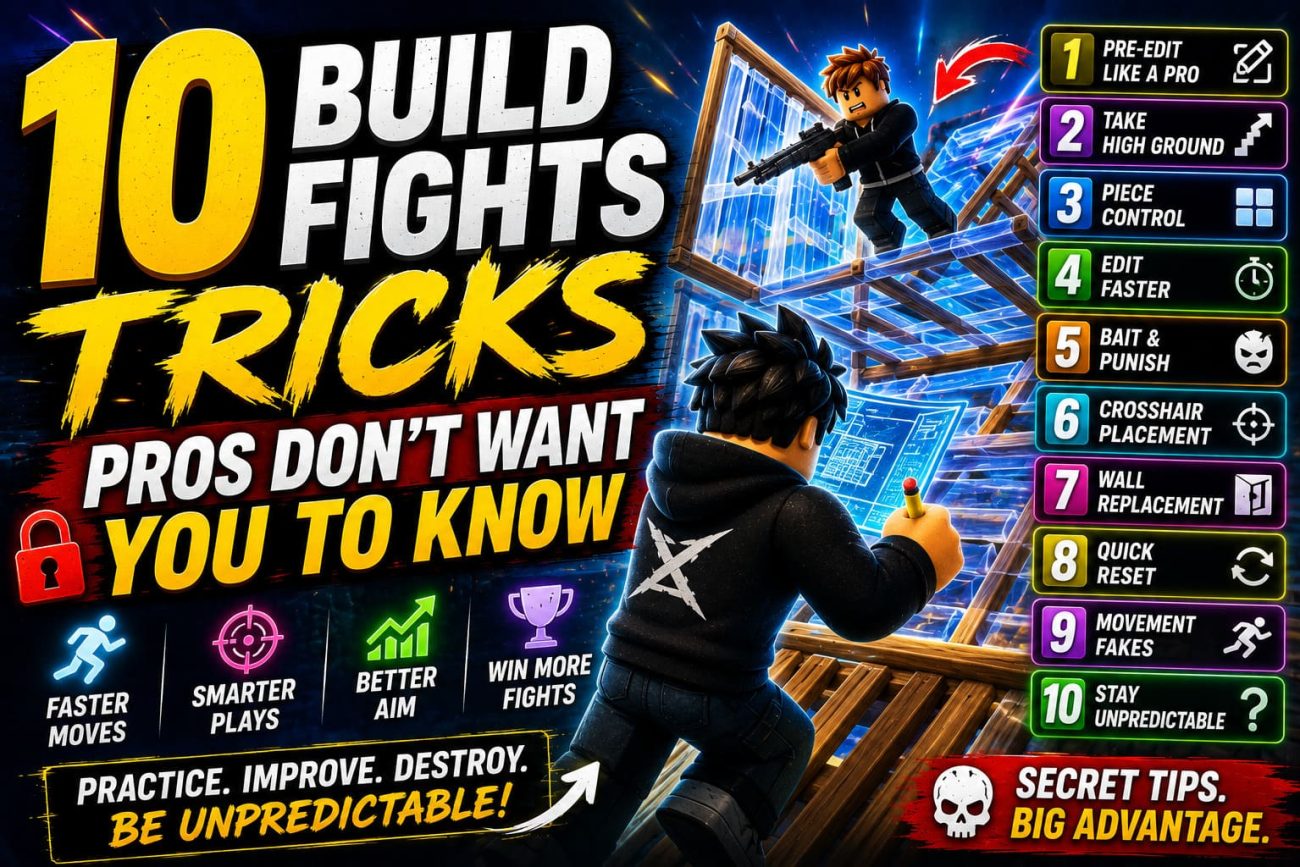
Build fights are one of the most recognizable parts of Fortnite’s gameplay. A good player doesn’t simply build as fast as possible—they use smart edits, positioning, movement, and timing to create favorable fights.
Professional players have spent thousands of hours practicing these mechanics, but many of the fundamentals can be learned by ordinary players with consistent practice.
This guide covers 10 practical build-fighting techniques that can help you become more confident in build fights.
Note: These aren’t secret tricks that automatically make you a professional. They are techniques commonly useful in Fortnite build fights, and their effectiveness depends on your timing, mechanics, positioning, and game sense.
1. Don’t Always Build Higher
One of the biggest mistakes newer players make is treating height as the only objective.
Getting high ground can be useful, but constantly building upward can waste materials and make your movement predictable.
Instead, think about controlling advantageous space.
Try this:
- Build enough to protect yourself.
- Watch your opponent’s movement.
- Look for opportunities to take an angle.
- Avoid unnecessary vertical builds.
- Keep track of your available materials.
Sometimes holding a slightly lower but better-protected position is safer than repeatedly trying to build above your opponent.
The lesson
Height is useful, but positioning is more important than simply being higher.
2. Use Cones to Control Space
Cones are extremely useful during build fights.
They can prevent opponents from moving freely through a box and can also help you control the space around an opponent.
A cone can be used to:
- Block movement
- Take control of an area
- Limit escape routes
- Create protected positions
- Set up edits
Instead of thinking of cones as something you place randomly, think about them as a way to control where your opponent can move.
3. Don’t Edit Every Piece You Place
Fast editing looks impressive, but unnecessary edits can create openings for your opponent.
Every edit changes your protection.
If you edit a wall and expose yourself without having a clear reason, your opponent may take advantage of the opening.
Before editing, ask:
“What am I gaining from this edit?”
Good reasons include:
- Creating a shooting angle
- Escaping
- Taking control of a piece
- Changing your position
- Creating an unexpected peek
If you don’t gain anything, keeping the structure intact may be better.
4. Learn the Right-Hand Peek
The right-hand peek is one of the most important concepts in Fortnite building.
The basic idea is to position yourself so that you can see your opponent while exposing as little of your character as possible.
Why it works
Your character model isn’t exposed equally from every angle.
Using the geometry of your builds effectively can allow you to take safer shots.
Practice it
Try placing a wall and editing an opening that allows you to peek from a favorable side.
Then practice:
Edit → aim → shoot → reset
The goal isn’t simply to edit quickly.
The goal is to create a favorable angle.
5. Use Fake Edits
Sometimes the best edit is one you don’t actually use.
You can begin an edit and then reset it without exposing yourself.
This can make your opponent think you’re about to attack.
For example:
- Prepare an edit.
- Let the opponent react.
- Cancel or reset.
- Change your position.
- Attack from another angle.
This can disrupt your opponent’s timing.
Why it works
Build fights aren’t only about mechanics.
They’re also about making your opponent react to information you control.
6. Don’t Repeat the Same Peek
If you take the same peek repeatedly, your opponent can predict you.
For example:
Peek → shoot → reset → peek from exactly the same location
After a few repetitions, an experienced player may pre-aim the opening.
Instead, vary your approach.
You can:
- Change the edit
- Change your position
- Attack from another side
- Wait longer
- Create a new opening
Unpredictability makes your opponent’s job harder.
7. Use Protected Retakes
When an opponent has height, many players immediately start building straight upward.
That can make you an easy target.
Instead, practice protected retakes.
Use combinations of:
- Ramps
- Walls
- Floors
- Cones
to create protection while changing elevation.
Basic principle
Don’t ask:
“How quickly can I get high ground?”
Ask:
“How can I gain space without giving my opponent an easy shot?”
This small change in mindset can significantly improve your build fights.
8. Use Movement to Make Your Opponent Miss
Your builds aren’t your only defense.
Movement is equally important.
If you’re standing still while editing or shooting, you’re giving your opponent a much easier target.
Use unpredictable movement when appropriate:
- Short strafes
- Direction changes
- Jumps when necessary
- Controlled repositioning
But don’t move randomly.
Good movement should help you maintain your aim and positioning.
Remember
Fast movement isn’t automatically good movement.
The goal is to make yourself difficult to hit while staying ready to shoot.
9. Learn When to Disengage
One of the most underrated build-fight skills is knowing when to stop fighting.
Sometimes the correct decision is to leave.
Disengaging can be smart when:
- You’re low on health
- You’re running out of materials
- Your opponent has a major positional advantage
- You’re losing the mechanical battle
- Another player is approaching
- You have no safe way to continue
Professional-level gameplay isn’t about winning every build fight.
It’s about making the decision that gives you the highest chance of surviving and eventually winning.
10. Turn the Build Fight Into a Box Fight
You don’t always need to continue building vertically.
If you can create a protected area around your opponent, you can transition the fight into a more controlled engagement.
The general idea is:
Build fight → control space → isolate opponent → create a protected angle → take the shot
This can be much more effective than endlessly cranking upward.
Why it works
Vertical build fights can consume a lot of materials.
A controlled close-range engagement may give you a better opportunity to finish the fight.
Bonus Trick: Watch Your Opponent’s Materials
Experienced players pay attention to more than their own resources.
If your opponent has been building continuously, they may eventually run low on materials.
You don’t necessarily need to rush them immediately.
Instead, consider forcing them to spend more resources while maintaining your own protection.
If they eventually run out of materials, their options become much more limited.
The Most Important Build-Fight Skills
If you’re trying to improve, don’t attempt to master all 10 techniques simultaneously.
Start with the fundamentals.
Beginner
Focus on:
- Basic 90s
- Ramp + wall protection
- Simple edits
- Right-hand peeks
- Basic box building
Intermediate
Work on:
- Protected retakes
- Piece control
- Cone placement
- Edit timing
- Movement
Advanced
Practice:
- Advanced retakes
- Piece-control combinations
- Fake edits
- Unpredictable peeks
- Fight decision-making
A Simple 20-Minute Build-Fight Practice Routine
You don’t need to spend hours practicing.
Try this short routine in Creative mode.
Minutes 1–5: Building
Practice:
- 90s
- Ramps
- Walls
- Floors
- Cones
Focus on consistency.
Minutes 6–10: Editing
Practice:
- Wall edits
- Cone edits
- Floor edits
- Edit resets
Try to maintain accuracy rather than simply maximizing speed.
Minutes 11–15: Piece Control
Practice placing structures around an opponent or target.
Focus on controlling space before taking the shot.
Minutes 16–20: Real Fights
Use realistic 1v1s or build fights.
Try to apply one technique you practiced.
Common Build-Fight Mistakes
Building Too Much
More builds don’t automatically mean better defense.
Build with a purpose.
Editing Too Quickly
Speed without accuracy creates mistakes.
Ignoring Your Materials
Always keep an eye on your available resources.
Taking Every Fight
Sometimes disengaging is the better play.
Repeating the Same Peek
Your opponent will eventually learn your pattern.
Focusing Only on High Ground
Positioning and protection matter more than simply being above your opponent.
Final Thoughts
The biggest difference between a beginner and an experienced Fortnite builder isn’t necessarily how quickly they can place structures.
It’s how intelligently they use those structures.
Good build fighting involves:
- Positioning
- Piece control
- Protection
- Editing
- Movement
- Timing
- Resource management
- Decision-making
Don’t try to copy every flashy technique you see from professional players.
Instead, master a few fundamentals and gradually build your mechanics around them.
Start with protected building, good crosshair placement, right-hand peeks, controlled edits, and smart positioning.
Once those become natural, advanced techniques become much easier to learn.
And remember:
The goal isn’t to build the most. The goal is to build with a purpose.
Frequently Asked Questions
What is the most important build-fight skill in Fortnite?
For most players, a combination of building protection, editing, piece control, and positioning is more important than simply building extremely fast.
How can I get better at Fortnite build fights?
Practice consistently in Creative mode. Spend time on basic building, editing, protected retakes, piece control, and realistic 1v1 fights.
Are fast edits necessary to win build fights?
Fast edits can help, but accuracy and decision-making are more important. An extremely fast edit isn’t useful if it exposes you unnecessarily or causes you to miss your shot.
Should I always try to take high ground?
No. High ground can be advantageous, but maintaining protection, controlling space, and managing your materials are also important.
What is piece control?
Piece control generally refers to placing your own builds around an opponent to limit their movement and create favorable opportunities to attack.
How long should I practice building every day?
There is no required amount of time. Even 15–30 minutes of focused practice can be useful if you have a specific skill you’re trying to improve.
Should beginners learn advanced retakes?
Not immediately. Beginners should first learn basic building, editing, movement, and protection. Advanced retakes are much easier once those fundamentals are consistent.
